Advertisements
Advertisements
Question
Calculate the mass of ice needed to cool 150 g of water contained in a calorimeter of mass 50 g at 32 °C such that the final temperature is 5 °C. Specific heat capacity of calorimeter = 0.4 J g-1 °C-1, Specific heat capacity of water = 4.2 J g-1°C-1, latent heat capacity of ice = 330 J g-1.
Advertisements
Solution
Heat lost by hot water = Heat gained by ice + Heat lost by calorimeter + Heat gained by melted ice
`("MC"Δ_t)_"water" + ("MC"Δ_t)_"calorimeter" = "MLL"_"F" + ("MC"Δ_t)_"Melted ice"`
∴ 150 × 4.2 (32 - 5) + 50 × 0.4 × (32 - 5) = M × 330 + M × 4.2 × (5 - 0)
∴ (150 × 4.2 × 27) + (50 × 0.4 × 27) = 330 M + 21 M
17010 + 540 = 351 M
∴ M = `17550/351`
∴ M = 50
Mass of ice required = 50g.
APPEARS IN
RELATED QUESTIONS
A child running a temperature of 101°F is given an antipyrin (i.e. a medicine that lowers fever) which causes an increase in the rate of evaporation of sweat from his body. If the fever is brought down to 98 °F in 20 min, what is the average rate of extra evaporation caused, by the drug? Assume the evaporation mechanism to be the only way by which heat is lost. The mass of the child is 30 kg. The specific heat of human body is approximately the same as that of water, and latent heat of evaporation of water at that temperature is about 580 cal g–1.
State two factors upon which the heat absorbed by a body depends
In an experiment to determine the specific heat capacity of a solid following operations were
made:
Mass of calorimeter + stirrer = x kg
Mass of water = y kg
Initial temperature of water t1℃
Mass of solid = z kg
Temperature of solid = t2 ℃
Temperature of mixture = t ℃
Specific heat capacity of calorimeter and water are c1 and c2 respectively. Express the specific
heat capacity c of the solid in terms of the above data.
Read the following paragraph and answer the questions.
|
If heat is exchanged between a hot and cold object, the temperature of the cold object goes on increasing due to gain of energy and the temperature of the hot object goes on decreasing due to loss of energy. The change in temperature continues till the temperatures of both the objects attain the same value. In this process, the cold object gains heat energy and the hot object loses heat energy. If the system of both the objects is isolated from the environment by keeping it inside a heat resistant box (meaning that the energy exchange takes place between the two objects only), then no energy can flow from inside the box or come into the box. |
- Heat is transferred from where to where?
- Which principle do we learn about from this process?
- How will you state the principle briefly?
- Which property of the substance is measured using this principle?
The ratio of specific heat capacity to molar heat capacity of a body _____________ .
Define heat capacity.
Write the approximate values of the specific latent heat of vaporization of steam.
The heat capacity of the vessel of mass 100 kg is 8000 J/°K. Find its specific heat capacity.
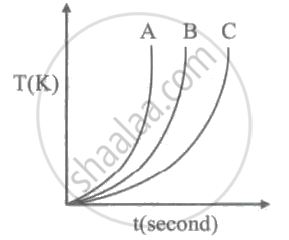
Which of the following substances (A, B and C) has the highest specific beat?
Two metals A and B have specific heat capacities in the ratio 2:3. If they are supplied same amount of heat then
If specific heat capacity of metal A is 0.26 Jg-1 0C-1 then calculate the specific heat capacity of metal B.
