Advertisements
Advertisements
प्रश्न
What are other units of heat? Name and define them.
Advertisements
उत्तर
(i) Calorie: It is the quantity of heat required to raise the temperature of 1 gm of water by 1°C (more accurately the rise in temperature is taken from 14.5°C to 15.5°C).
(ii) Kilo calorie: It is the quantity of heat required to raise the temperature of 1 kg of water by 1°C. It is equivalent to 1000 calories.
संबंधित प्रश्न
What amount of heat must be supplied to 2.0 x 10⁻² kg of nitrogen (at room temperature) to raise its temperature by 45 °C at constant pressure? (Molecular mass of N2 = 28; R = 8.3 J mol-1 K-1.)
Calculate the mass of ice required to lower the temperature of 300 g of water 40°C to water at 0°C.
(Specific latent heat of ice = 336 J/g, the Specific heat capacity of water = 4.2J/g°C)
Heat energy is supplied at a constant rate to 100g of ice at 0 °C. The ice is converted into water at 0° C in 2 minutes. How much time will be required to raise the temperature of water from 0 °C to 20 °C? [Given: sp. heat capacity of water = 4.2 J g-1 °C-1, sp. latent heat of ice = 336 J g-1].
The specific heat capacity of a body depends on _____________ .
The substances like water which have ........... Heat capacity warm up more slowly than substances like iron which have .......... heat capacity.
63.2 g of copper at 50°C can just melt 3.8g of ice. If the specific latent heat of ice is 336 J/g, find the specific heat capacity of copper.
The specific heat capacity of water is 1 cal/g °C.
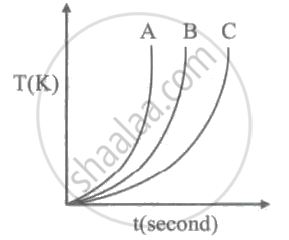
Which of the following substances (A, B and C) has the highest specific beat?
The ratio of the specific heats `c_"p"/c_"v"=gamma` in terms of degrees of freedom 'n' is given by ______.
J/Kg °C is the unit of specific heat capacity.
