Advertisements
Advertisements
प्रश्न
In an experiment on the specific heat of a metal, a 0.20 kg block of the metal at 150 °C is dropped in a copper calorimeter (of water equivalent 0.025 kg) containing 150 cm3 of water at 27 °C. The final temperature is 40 °C. Compute the specific heat of the metal. If heat losses to the surroundings are not negligible, is your answer greater or smaller than the actual value for the specific heat of the metal?
Advertisements
उत्तर १
Mass of the metal, m = 0.20 kg = 200 g
Initial temperature of the metal, T1 = 150°C
Final temperature of the metal, T2 = 40°C
Calorimeter has water equivalent of mass, m’ = 0.025 kg = 25 g
Volume of water, V = 150 cm3
Mass (M) of water at temperature T = 27°C:
150 × 1 = 150 g
Fall in the temperature of the metal:
ΔT = T1 – T2 = 150 – 40 = 110°C
Specific heat of water, Cw = 4.186 J/g/°K
Specific heat of the metal = C
Heat lost by the metal, θ = mCΔT … (i)
Rise in the temperature of the water and calorimeter system:
ΔT′’ = 40 – 27 = 13°C
Heat gained by the water and calorimeter system:
Δθ′′ = m1 CwΔT’
= (M + m′) Cw ΔT’ … (ii)
Heat lost by the metal = Heat gained by the water and colorimeter system
mCΔT = (M + m’) Cw ΔT’
200 × C × 110 = (150 + 25) × 4.186 × 13
`:. C = (175xx4.186xx13)/(110xx200) = 0.43 J g^(-1) K^(-1)`
If some heat is lost to the surroundings, then the value of C will be smaller than the actual value.
उत्तर २
Mass of metal block, m = 0.20 kg = 200 g
Fall in the temperature of metal block,
ΔT = (150 – 40) °C = 110 °C
If C be the specific heat of metal, then heat lost by the metal block = 200 x C x 110 cal Volume of water = 150 cm3
mass of water = 150 g
Increase in temperature of water = (40 – 27) °C = 13°C
Heat gained by water = 150 x 13 cal Water equivalent of calorimeter, w = 0.025 kg = 25g
Heat gained by calorimeter, `"w x increase in temperature of calorimeter"`
= 25 x 13 cal
Heat lost by metal block = Heat gained by water + Heat gained by calorimeter
200 x C x 110 = (150 + 25 ) 13
`C = (175xx13)/(200xx100) = 0.1 Cal g^(-1) ""^@C^(-1) = 0.43 J g^(-1) K^(-1)`
if heat is lost to the surroundings, C will be smaller then the actual value
APPEARS IN
संबंधित प्रश्न
A copper vessel of mass 100 g contains 150 g of water at 50°C. How much ice is needed to cool it to 5°C?
Given: Specific heat capacity of copper = 0.4 Jg-1 °C-1
The Specific heat capacity of water = 4.2 Jg-1 °C-1
The Specific latent heat of fusion ice = 336 Jg-1
A solid metal weighing 150 g melts at its melting point of 800 °C by providing heat at the rate of 100 W. The time taken for it to completely melt at the same temperature is 4 min. What is the specific latent heat of fusion of the metal?
Name the S.I. unit of heat.
Give one example where high specific heat capacity of water is used as heat reservoir ?
Describe a method to determine the specific heat capacity of a solid, like a piece of copper ?
Find the time taken by a 500 W heater to raise the temperature of 50 kg of material of specific heat capacity 960 J kg-1K-1, from 18°C to 38° C. Assume that all the heat energy supplied by the heater is given to the material.
Explain the term boiling point ?
Ice cream appears colder to the mouth than water at 0℃. Give reason.
How does green house effect help in keeping the temperature of earth’s surface suitable for living of human beings?
How will rise in sea level affect population in coastal countries?
What impact will climate changes have on the crops of food?
How will global warming disturb the ecological balance?
What is meant by specific heat capacity?
In Regnault's apparatus for measuring specific heat capacity of a solid, there is an inlet and an outlet in the steam chamber. The inlet is near the top and the outlet is near the bottom. Why is it better than the opposite choice where the inlet is near the bottom and the outlet is near the top?
A piece of iron of mass 2.0 kg has a heat capacity of 966 J K-1. Find its specific heat capacity in S.I unit.
What are other units of heat? Name and define them.
Does the specific heat capacity of a substance depend upon its mass and rise in temperature only?
Write the approximate values of the specific latent heat of vaporization of steam.
Explain, why temperature in hot summer, falls sharply after a sharp shower?
Explain, why water is considered as best liquid for quenching thirst?
Explain, why does a wise farmer water his fields, if forecast is forst?
Give two reasons as to why copper is preferred over other metals for making calorimeters.
Why are athletes advised to put on extra clothes after competing on event?
Describe a method to determine the specific heat capacity of a solid (say, a piece of copper).
Answer the following question.
Why do we generally consider two specific heats of a gas?
State factors on which the amount of heat radiated by a body depends.
Decide the unit for specific heat capacity.
Read the passage and answer the questions based on it.
If heat is exchanged between a hot and cold object, the temperature of the cold object goes on increasing due to gain of energy and the temperature of the hot object goes on decreasing due to loss of energy. The change in temperature continues till the temperatures of both objects attain the same value. In this process, the cold object gains heat energy and the hot object loses heat energy. If the system of both the objects is isolated from the environment by keeping it inside a heat-resistant box then no energy can flow from inside the box or come into the box. In this situation, we get the following principle.
Heat energy lost by the hot object = Heat energy gained by the cold object. This is called the ‘Principle of heat exchange’.
- Where does heat transfer take place?
- In such a situation which principle of heat do you perceive?
- How can this principle be explained in short?
- Measuring the property of which substance this principle is used?
Numerical Problem.
How much heat energy is required to change 2 kg of ice at 0°C into water at 20°C? (Specific latent heat of fusion of water = 3,34,000 J/kg, Specific heat capacity of water = 4200 JKg–1K–1).
If 'Cp' and 'Cv' are molar specific heats of an ideal gas at constant pressure and volume respectively. If 'λ' is the ratio of two specific heats and 'R' is universal gas constant then 'Cp' is equal to ______.
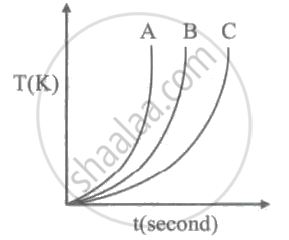
Which of the following substances (A, B and C) has the highest specific beat?
The molar specific heats of an ideal gas at constant pressure and constant volume are denoted by Cp and Cv respectively. If `gamma = "C"_"p"/"C"_"v"` and R is the universal gas constant, then Cp is equal to ______.
A metal ball of heat capacity 50J/°C loses 2000 J of heat. By how much will its temperature fall?
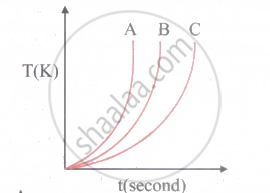
Which of the following substances (A, B and C) has the highest specific heat?
The difference between the two molar specific heats of gas is 9000 J/kg K. If the ratio of the two specific heats is 1.5, calculate the two molar specific heats.
Prove the Mayer's relation `C_p - C _v = R/J`
Which method is used to determine the specific heat capacity of both solids and liquids by mixing a substance of unknown specific heat with water?
