Advertisements
Advertisements
प्रश्न
Read the passage and answer the questions based on it.
If heat is exchanged between a hot and cold object, the temperature of the cold object goes on increasing due to gain of energy and the temperature of the hot object goes on decreasing due to loss of energy. The change in temperature continues till the temperatures of both objects attain the same value. In this process, the cold object gains heat energy and the hot object loses heat energy. If the system of both the objects is isolated from the environment by keeping it inside a heat-resistant box then no energy can flow from inside the box or come into the box. In this situation, we get the following principle.
Heat energy lost by the hot object = Heat energy gained by the cold object. This is called the ‘Principle of heat exchange’.
- Where does heat transfer take place?
- In such a situation which principle of heat do you perceive?
- How can this principle be explained in short?
- Measuring the property of which substance this principle is used?
Advertisements
उत्तर
- Heat is transferred from hot object to cold object.
- During the transfer of heat from hot object to cold object we perceive the principle of heat exchange.
- As inside the heat resistant box, the heat lost by hot object exactly equals heat gained by cold object, principle of heat exchange is stated as:
In an isolated system,
Heat energy lost by hot object = Heat energy gained by cold object. - Specific heat of the substance is measured using the principle of heat exchange.
APPEARS IN
संबंधित प्रश्न
What property of water makes it an effective coolant?
A solid metal weighing 150 g melts at its melting point of 800 °C by providing heat at the rate of 100 W. The time taken for it to completely melt at the same temperature is 4 min. What is the specific latent heat of fusion of the metal?
The temperature of 170 g of water at 50°C is lowered to 5°C by adding a certain amount of ice to it. Find the mass of ice added.
Given: Specific heat capacity of water = 4200 J kg-1 °C-1 and specific latent heat of ice = 336000 J kg-1.
Discuss the role of high specific heat capacity of water with reference to climate in coastal areas.
Give three reasons for the increase of green house gases.
The global warming has resulted:
(a) the increase in yield of crops
(b) the decrease in sea levels
(c) the decrease in human deaths
(d) the increase in sea levels
How will you prove experimentally that different substances have different specific heat capacities?
In Regnault's apparatus for measuring specific heat capacity of a solid, there is an inlet and an outlet in the steam chamber. The inlet is near the top and the outlet is near the bottom. Why is it better than the opposite choice where the inlet is near the bottom and the outlet is near the top?
104g of water at 30°C is taken in a calorimeter made of copper of mass 42 g. When a certain mass of ice at 0°C is added to it, the final steady temperature of the mixture after the ice has melted, was found to be 10°C. Find the mass of ice added. [Specific heat capacity of water = 4.2 Jg–1°C–1 ; Specific latent heat of fusion of ice = 336 Jg–1; Specific heat capacity of copper = 0.4 Jg–1°C–1] .
Define the term 'specific heat capacity' and state its unit.
Water boils at 120 °C in a pressure cooker. Explain the reason.
What are other units of heat? Name and define them.
Write two advantages of high specific heat capacity of water.
Water falls from a height of 50 m. Calculate the rise in the temperature of water when it strikes the bottom.
(g = 10 ms-2; Specific heat capacity of water = 4200 J / kg°C)
A. hot solid of mass 60 g at 100°C is placed in 150 g of water at 20° C. The final steady temperature recorded is 25°C. Calculate the specific heat capacity of the solid. [Specific heat capacity of water = 4200 J kg-1 °C-1]
All metals have the same specific heat capacity.
On supplying 100 µC of charge to a conductor, its potential rises by 5 V then capacity of the conductor is ______.
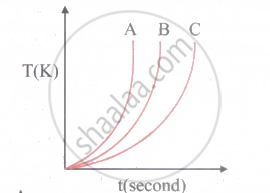
Which of the following substances (A, B and C) has the highest specific heat?