Advertisements
Advertisements
प्रश्न
The specific heat capacity of a body depends on _____________ .
पर्याय
the heat given
the temperature raised
the mass of the body
the material of the body
Advertisements
उत्तर
the material of the body
Heat capacity of a body is due to their material properties. Due to different molecular structures, different bodies have a different capacity to absorb heat. Therefore, specific heat of a body depends on the material of the body.
APPEARS IN
संबंधित प्रश्न
What amount of heat must be supplied to 2.0 x 10⁻² kg of nitrogen (at room temperature) to raise its temperature by 45 °C at constant pressure? (Molecular mass of N2 = 28; R = 8.3 J mol-1 K-1.)
The coolant in a chemical or a nuclear plant (i.e., the liquid used to prevent the different parts of a plant from getting too hot) should have high specific heat.
What do you understand by the following statements:
The heat capacity of the body is 60JK-1.
State two factors upon which the heat absorbed by a body depends
Water in lakes and ponds do not freeze at once in cold countries. Give a reason is support of your answer.
Heat energy is supplied at a constant rate to 100g of ice at 0 °C. The ice is converted into water at 0° C in 2 minutes. How much time will be required to raise the temperature of water from 0 °C to 20 °C? [Given: sp. heat capacity of water = 4.2 J g-1 °C-1, sp. latent heat of ice = 336 J g-1].
During the phase change does the average kinetic energy of the molecules of the substance increase?
The S.I. unit of specific heat capacity is ______.
Name three fossil fuels that emit carbon dioxide into the atmosphere ?
State the effect of enhancement of green house effect.
How will climate changes affect the various animal species?
State three ways to minimize the global warming.
Equal heat is given to two objects A and B of mass 1 g. Temperature of A increases by 3°C and B by 5°C. Which object has more specific heat? And by what factor?
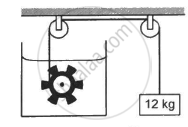
Figure shows a paddle wheel coupled to a mass of 12 kg through fixed frictionless pulleys. The paddle is immersed in a liquid of heat capacity 4200 J K−1 kept in an adiabatic container. Consider a time interval in which the 12 kg block falls slowly through 70 cm. (a) How much heat is given to the liquid? (b) How much work is done on the liquid? (c) Calculate the rise in the temperature of the liquid neglecting the heat capacity of the container and the paddle.
The product of mass and specific heat is known as ..........
State, with reason, which of the two, boiling water or steam both at 100°C will produce more severe burns.
What are the factors on which the quantity of heat given to a body depends?
Name the substance which has maximum specific heat capacity.
Explain, why is water sprayed on roads in evening in hot summer?
An equal quantity of heat is supplied to two substances A and B. The substance A shows a greater rise in temperature. What can you say about the heat capacity of A as compared to that of B?
Discuss how high specific heat capacity of water helps in formation of land and sea breeze.
The temperature of a lead piece of mass 400 g rises from 20°C to 50°C when 1560 J of heat is supplied to it. Calculate: Heat capacity of lead piece.
A piece of iron of mass 2.0 kg has a thermal capacity of 966 J/°C. What is its specific heat capacity in S.I. units?
Calculate the amount of heat released when 5.0 g of water at 20°C is changed into ice at 0°C.
(Specific heat capacity of water = 4.2 J/g°C
Specific latent heat of fusion of ice = 336 J/g)
Solve the following problem.
What is the specific heat of metal if 50 cal of heat is needed to raise 6 kg of the metal from 20°C to 62 °C?
From the options given below the specific heat of _______ is maximum.
_______ is defined as the amount of heat required to raise the temperature of 1kg of a substance by 1°C.
Consider the statement given below and choose the correct option.
Assertion: Radiation is a form of heat transfer which takes place only in vacuum.
Reason: The thermal energy is transferred from one part of a substance to another part without the actual movement of the atoms or molecules.
Explain why the specific heat capacity at constant pressure is greater than the specific heat capacity at constant volume.
50 g of copper is heated to increase its temperature by 10° C. If the same quantity of heat is given to 5 g water, the rise in its temperature is [Specific heat of copper = 420 joule-kg-1 °C-1 , specific heat of water = 4200 joule-kg-I °C-1]
The value of 'γ' for a gas is given as `gamma = 1 + 2/"f"`, where 'f ' is the number of degrees of freedom of freedom of a molecule of a gas. What is the ratio of `gamma_"monoatonic"//gamma_"diatomic"`?
Diatomic gas consists of rigid gas molecules
Specific heat capacity of a substance X is 1900 Jkg-1°C-1 means ______.
Thermal capacities of substances A and B are same. If mass of A is more than mass of B then:
Which substance will have more specific heat capacity?
Calculate the amount of heat energy required to raise the temperature of 200 g of copper from 20°C to 70°C. Specific heat capacity of copper = 390 J kg-1 K-1.
