Advertisements
Advertisements
प्रश्न
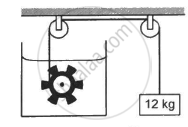
Figure shows a paddle wheel coupled to a mass of 12 kg through fixed frictionless pulleys. The paddle is immersed in a liquid of heat capacity 4200 J K−1 kept in an adiabatic container. Consider a time interval in which the 12 kg block falls slowly through 70 cm. (a) How much heat is given to the liquid? (b) How much work is done on the liquid? (c) Calculate the rise in the temperature of the liquid neglecting the heat capacity of the container and the paddle.
Advertisements
उत्तर
(a) Heat is not given to the liquid; instead, the mechanical work done is converted to heat. Also the container is adiabatic. So, no heat can enter or exit the system. This implies that the heat given to the liquid is zero.
(b) Since the 12 kg mass falls through a distance of 70 cm under gravity, energy is lost by this mass. As this mass is connected to the paddle wheel, energy lost by this mass is gained by the paddle wheel.
⇒">⇒ Work done on the liquid = PE lost by the 12 kg mass
Now,
PE lost by the 12 kg mass = mgh
= 12 × 10 × 0.70
= 84 J
(c) Suppose ∆t is the rise in temperature of the paddle wheel when the system gains energy.
⇒">⇒ 84 = ms∆t
If s is the specific heat of the system, then
84 = 1 × 4200 × ∆t .........(for 'm' = 1 kg)
\[∆ t = \frac{84}{4200} = \frac{1}{50} = 0 . 02 K\]
APPEARS IN
संबंधित प्रश्न
In an experiment on the specific heat of a metal, a 0.20 kg block of the metal at 150 °C is dropped in a copper calorimeter (of water equivalent 0.025 kg) containing 150 cm3 of water at 27 °C. The final temperature is 40 °C. Compute the specific heat of the metal. If heat losses to the surroundings are not negligible, is your answer greater or smaller than the actual value for the specific heat of the metal?
Specific heat capacity of substance A is 3.8 J g-1K-1 whereas the specific heat capacity of substance B is 0.4 J g-1 K-1
(i) Which of the two is a good conductor of heat?
(ii) How is one led to the above conclusion?
(iii) If substances A and B are liquids then which one would be more useful in car radiators?
Give one example where high specific heat capacity of water is used as cooling purposes?
Give three reasons for the increase of green house gases.
How will rise in sea level affect population in coastal countries?
The specific heat capacity of a body depends on _____________ .
(i) State whether the specific heat capacity of a substance remains the same when its state changes from solid to liquid.
(ii) Give one example to support your answer.
104g of water at 30°C is taken in a calorimeter made of copper of mass 42 g. When a certain mass of ice at 0°C is added to it, the final steady temperature of the mixture after the ice has melted, was found to be 10°C. Find the mass of ice added. [Specific heat capacity of water = 4.2 Jg–1°C–1 ; Specific latent heat of fusion of ice = 336 Jg–1; Specific heat capacity of copper = 0.4 Jg–1°C–1] .
The substances like water which have ........... Heat capacity warm up more slowly than substances like iron which have .......... heat capacity.
(b) 2000 J of heat energy is required to raise the temperature of 4 kg of a
metal by 3°c. Which expression gives the specific heat capacity of the metal?
Fill in the following blank using suitable word:
SI unit of heat is .........
Does the specific heat capacity of a substance depend upon its mass and rise in temperature only?
Write the approximate values of the specific latent heat of fusion of ice.
Write the approximate values of the specific latent heat of vaporization of steam.
Why is specific heat capacity taken as a measure of thermal inertia?
Explain, why do sandy soils, get heated up quickly as compared to wet soils?
Some heat is provided to a body to raise its temperature by 25°C. What will be the corresponding rise in temperature of the body as shown on the Kelvin scale?
Will the value of specific heat’capacity and specific latent heat of a substance change if the scale is °F instead of °C?
A piece of ice is heated at a constant rate. The variation of temperature with heat input is shown in the graph below:

(i) What are represented by AB and CD?
(ii) What conclusion can you draw regarding the 110°c nature of ice from the above graph?
63.2 g of copper at 50°C can just melt 3.8g of ice. If the specific latent heat of ice is 336 J/g, find the specific heat capacity of copper.
Write a short note.
Specific heat capacity
_______ is defined as the amount of heat required to raise the temperature of 1kg of a substance by 1°C.
Explain why the specific heat capacity at constant pressure is greater than the specific heat capacity at constant volume.
For a gas, `"R"/"C"_"v"=0.4`, where R Is universal gas constant and Cv is the molar specific heat at constant volume. The gas is made up of molecules, which are ______
50 g of copper is heated to increase its temperature by 10° C. If the same quantity of heat is given to 5 g water, the rise in its temperature is [Specific heat of copper = 420 joule-kg-1 °C-1 , specific heat of water = 4200 joule-kg-I °C-1]
Two uniform brass rods A and B of length land 2l and radii 2r and r respectively are heated to the same temperature. The ratio of the increase in the volume ofB to that of A is ____________.
A monoatomic gas of pressure 'P' having volume 'V' expands isothermally to a volume '2V' and then adiabatically to a volume '16V'. The final pressure of the gas is ______.
(ratio of specific heats = `5/3`)
At same temperature and pressure of an ideal gas, ____________.
Water has the lowest specific heat capacity.
Match the following:
| Column A | Column B | ||
| 1. | Specific heat capacity of water | a. | 0°C |
| 2. | Latent heat of fusion of ice | b. | 2260 J/g |
| 3. | Latent heat of vaporization of water | c. | 100°C |
| 4. | The melting point of iced | d. | 4.2 J/g°C |
| 5. | The boiling point of water | e. | 336 J/g |
A metal ball of heat capacity 50J/°C loses 2000 J of heat. By how much will its temperature fall?
Which of the following substances (A, B and C) has the highest specific heat?