Advertisements
Advertisements
प्रश्न
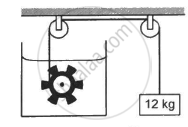
Figure shows a paddle wheel coupled to a mass of 12 kg through fixed frictionless pulleys. The paddle is immersed in a liquid of heat capacity 4200 J K−1 kept in an adiabatic container. Consider a time interval in which the 12 kg block falls slowly through 70 cm. (a) How much heat is given to the liquid? (b) How much work is done on the liquid? (c) Calculate the rise in the temperature of the liquid neglecting the heat capacity of the container and the paddle.
Advertisements
उत्तर
(a) Heat is not given to the liquid; instead, the mechanical work done is converted to heat. Also the container is adiabatic. So, no heat can enter or exit the system. This implies that the heat given to the liquid is zero.
(b) Since the 12 kg mass falls through a distance of 70 cm under gravity, energy is lost by this mass. As this mass is connected to the paddle wheel, energy lost by this mass is gained by the paddle wheel.
⇒">⇒ Work done on the liquid = PE lost by the 12 kg mass
Now,
PE lost by the 12 kg mass = mgh
= 12 × 10 × 0.70
= 84 J
(c) Suppose ∆t is the rise in temperature of the paddle wheel when the system gains energy.
⇒">⇒ 84 = ms∆t
If s is the specific heat of the system, then
84 = 1 × 4200 × ∆t .........(for 'm' = 1 kg)
\[∆ t = \frac{84}{4200} = \frac{1}{50} = 0 . 02 K\]
APPEARS IN
संबंधित प्रश्न
Given below are observations on molar specific heats at room temperature of some common gases.
| Gas |
Molar specific heat (Cv) (cal mol–1 K–1) |
| Hydrogen | 4.87 |
| Nitrogen | 4.97 |
| Oxygen | 5.02 |
| Nitric oxide | 4.99 |
| Carbon monoxide | 5.01 |
| Chlorine | 6.17 |
The measured molar specific heats of these gases are markedly different from those for monatomic gases. Typically, molar specific heat of a monatomic gas is 2.92 cal/mol K. Explain this difference. What can you infer from the somewhat larger (than the rest) value for chlorine?
Calculate the mass of ice required to lower the temperature of 300 g of water 40°C to water at 0°C.
(Specific latent heat of ice = 336 J/g, the Specific heat capacity of water = 4.2J/g°C)
A solid metal weighing 150 g melts at its melting point of 800 °C by providing heat at the rate of 100 W. The time taken for it to completely melt at the same temperature is 4 min. What is the specific latent heat of fusion of the metal?
Heat supplied to a solid change it into liquid. What is this change in the phase called?
Write the expression for the heat energy Q received by the substance when m kg of substance of specific heat capacity c Jkg-1 k-1 is heated through Δt° C.
Describe a method to determine the specific heat capacity of a solid, like a piece of copper ?
How does green house effect help in keeping the temperature of earth’s surface suitable for living of human beings?
Indian style of cooling drinking water is to keep it in a pitcher having porous walls. Water comes to the outer surface very slowly and evaporates. Most of energy needed for evaporation is taken from the water itself and the water is cooled down. Assume that a pitcher contains 10 kg of water and 0.2 g of water comes out per second. Assuming no backward heat transfer from the atmosphere to the water, calculate the time in which the temperature decrease by 5°C. Specific heat capacity of water = 4200 J kg−1 °C−1 and latent heat of vaporization of water = 2.27 × 10⁶ J kg−1.
The substances like water which have ........... Heat capacity warm up more slowly than substances like iron which have .......... heat capacity.
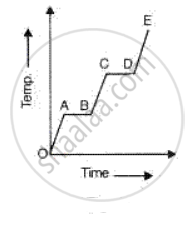
A substance is heated at a constant rate from a low temperature to a high temperature. A graph of temperature against time is shown in the figure. Which part or parts of the graph correspond(s) to the substance existing in two states?
Specific heat capacity of a substance A is 3.8 J g-1 K-1 and of substance B is 0.4 J g-1 k-1. Which substance is a good conductor of heat? How did you arrive at your conclusion?
Write the approximate values of the specific latent heat of vaporization of steam.
Explain, why water is considered as best liquid for quenching thirst?
Explain, why does a wise farmer water his fields, if forecast is forst?
Why are athletes advised to put on extra clothes after competing on event?
The temperature of a lead piece of mass 400 g rises from 20°C to 50°C when 1560 J of heat is supplied to it. Calculate Specific heat capacity of lead.
63.2 g of copper at 50°C can just melt 3.8g of ice. If the specific latent heat of ice is 336 J/g, find the specific heat capacity of copper.
An electric immersion heater is rated 1250 W. Calculate the time in which it will heat 20 kg of water at 5°C to 65°C.
Solve the following problem.
What is the specific heat of metal if 50 cal of heat is needed to raise 6 kg of the metal from 20°C to 62 °C?
Calculate the ratio of two specific heats of polyatomic gas molecules.
Derive Mayer’s relation.
The heat capacity of the vessel of mass 100 kg is 8000 J/°K. Find its specific heat capacity.
A diatomic gas undergoes adiabatic change. Its pressure 'P' and temperature 'T' are related as p ∝ Tx, where x is ______.
Which of the substances P, Q, or R has the lowest specific heat? The temperature v/s time graph is shown ______.

The molar specific heats of an ideal gas at constant pressure and constant volume are denoted by Cp and Cv respectively. If `gamma = "C"_"p"/"C"_"v"` and R is the universal gas constant, then Cp is equal to ______.
A monoatomic gas of pressure 'P' having volume 'V' expands isothermally to a volume '2V' and then adiabatically to a volume '16V'. The final pressure of the gas is ______.
(ratio of specific heats = `5/3`)
A piece of lead weighing 500 g gives out 1200 calories of heat when it is cooled from 100° C to 20° C. Find its specific heat.
The diagram below shows a cooling curve for 200 g of water. The heat is extracted at the rate of 100 Js-1. Answer the questions that follow:
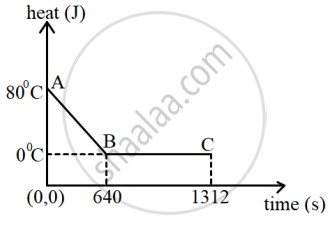
- Calculate specific heat capacity of water.
- Heat released in the region BC.
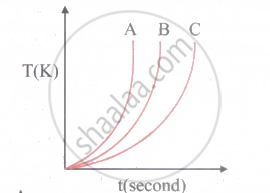
Which of the following substances (A, B and C) has the highest specific heat?
A geyser heats water flowing at a rate of 2.0 kg per minute from 30°C to 70°C. If the geyser operates on a gas burner, the rate of combustion of fuel will be ______ g min-1.
[Heat of combustion = 8 × 10³ Jg-1 Specific heat of water = 4.2 Jg-1°C-1]
Specific heat capacity of a substance X is 1900 Jkg-1°C-1 means ______.
