Advertisements
Advertisements
प्रश्न
Indian style of cooling drinking water is to keep it in a pitcher having porous walls. Water comes to the outer surface very slowly and evaporates. Most of energy needed for evaporation is taken from the water itself and the water is cooled down. Assume that a pitcher contains 10 kg of water and 0.2 g of water comes out per second. Assuming no backward heat transfer from the atmosphere to the water, calculate the time in which the temperature decrease by 5°C. Specific heat capacity of water = 4200 J kg−1 °C−1 and latent heat of vaporization of water = 2.27 × 10⁶ J kg−1.
Advertisements
उत्तर
Given:-
Specific heat of water ,S = 4200 J kg−1 °C−1
Latent heat of vapourisation of water ,L = 2.27 × 10⁶ J kg−1
Mass, M = 0.2 g = 0.0002 kg
Let us first calculate the amount of energy required to decrease the temperature of 10 kg of water by 5°C.
U1 = 10 × 4200 J/kg°C × 5°C
U1 = 210,000 = 21 × 104 J
Let the time in which the temperature is decreased by 5°C be t.
Energy required per second for evaporation of water (at the rate of 0.2 g/sec) is given by
U2 = ML
U2 = (2 × 10⁻⁴ )× (2.27 × 10⁶) = 454 J
Total energy required to decrease the temperature of the water = 454 × t
= 21 × 104 J
Now,
\[t= \frac{21 \times {10}^4}{454}\text{ seconds}\]
The time taken in minutes is given by
\[t= \frac{21 \times {10}^4}{454 \times 60} = 7 . 7\text{ minutes}\]
∴ The time required to decrease the temperature by 5°C is 7.7 minutes.
APPEARS IN
संबंधित प्रश्न
A liquid X has the maximum specific heat capacity and is used as a coolant in Car Radiators. Name the liquid X.
The temperature of 170 g of water at 50°C is lowered to 5°C by adding a certain amount of ice to it. Find the mass of ice added.
Given: Specific heat capacity of water = 4200 J kg-1 °C-1 and specific latent heat of ice = 336000 J kg-1.
What do you mean by the following statement?
The specific heat capacity of copper is 0. 4 Jg-1 K-1?
Discuss the role of high specific heat capacity of water with reference to climate in coastal areas.
Why do bottled soft drinks get cooled, more quickly by the ice cubes than by the iced water, both at 0℃?
Name the radiations for which the green house gases are transparent ?
How will rise in sea level affect population in coastal countries?
What impact will climate changes have on the crops of food?
What is carbon tax?
Who shall pay carbon tax ?
(i) State whether the specific heat capacity of a substance remains the same when its state changes from solid to liquid.
(ii) Give one example to support your answer.
104g of water at 30°C is taken in a calorimeter made of copper of mass 42 g. When a certain mass of ice at 0°C is added to it, the final steady temperature of the mixture after the ice has melted, was found to be 10°C. Find the mass of ice added. [Specific heat capacity of water = 4.2 Jg–1°C–1 ; Specific latent heat of fusion of ice = 336 Jg–1; Specific heat capacity of copper = 0.4 Jg–1°C–1] .
The substances like water which have ........... Heat capacity warm up more slowly than substances like iron which have .......... heat capacity.
Specific heat capacity of a substance A is 3.8 J g-1 K-1 and of substance B is 0.4 J g-1 k-1. Which substance is a good conductor of heat? How did you arrive at your conclusion?
What are other units of heat? Name and define them.
Name the substance which has maximum specific heat capacity.
Write two advantages of high specific heat capacity of water.
Does the specific heat capacity of a substance depend upon its mass and rise in temperature only?
If, in a central heating system, steam enters a radiation pipe at 100°C and water leaves the radiation pipe at 100°C, can this radiation pipe heat a room? Give an explanation for your answer.
Ice-cream at 0°C feels colder than water at 0°C. Give reason for this observation.
Will the value of specific heat’capacity and specific latent heat of a substance change if the scale is °F instead of °C?
A substance is in the form of a solid at 0°C. The amount of heat added to this substance and the temperature of the substance are plotted on the following graph:
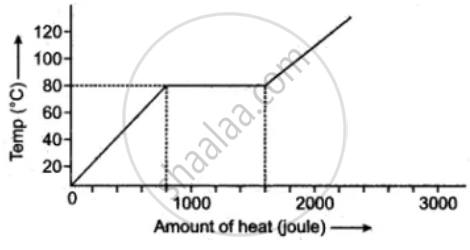
If the specific heat capacity of the solid substance is 500 J/kg °G, find from the graph, the mass of the substance.
A. hot solid of mass 60 g at 100°C is placed in 150 g of water at 20° C. The final steady temperature recorded is 25°C. Calculate the specific heat capacity of the solid. [Specific heat capacity of water = 4200 J kg-1 °C-1]
Calculate the amount of heat released when 5.0 g of water at 20°C is changed into ice at 0°C.
(Specific heat capacity of water = 4.2 J/g°C
Specific latent heat of fusion of ice = 336 J/g)
Derive an expression for finding out the specific heat capacity of a body (solid) from the readings of an experiment given below:
(i) Mass of empty calorimeter (with stirrer) = m1 gm
(ii) Mass of the metal piece = M gm
(iii) Mass of colorimeter and water = m2 gm
(iv) Initial temperature and water = t1°C
(v) Temperature of hot solid (metal piece) = t2 °C
(vi) Final temperature of the mixture = t°C
(vii) Specific heat of calorimeter = 0.4 J gm / °C
Answer the following question.
Why do we generally consider two specific heats of a gas?
Decide the unit for specific heat capacity.
The heat capacity of the vessel of mass 100 kg is 8000 J/°K. Find its specific heat capacity.
Explain why the specific heat capacity at constant pressure is greater than the specific heat capacity at constant volume.
Express the change in internal energy in terms of molar specific heat capacity.
Derive Meyer’s relation for an ideal gas.
Which of the substances P, Q, or R has the lowest specific heat? The temperature v/s time graph is shown ______.

A monoatomic gas of pressure 'P' having volume 'V' expands isothermally to a volume '2V' and then adiabatically to a volume '16V'. The final pressure of the gas is ______.
(ratio of specific heats = `5/3`)
Why is water used as a coolant in radiators of a car?
What is the amount of heat required to raise the temperature of 5 kg of iron from 30°C to 130°C? Specific heat capacity of iron = 483 Jkg-1C-1.
Which of the following substances (A, B and C) has the highest specific heat?
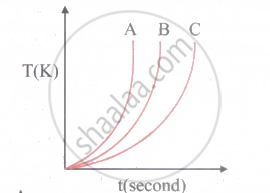
A 0.2 kg metal at 150°C is placed in a copper calorimeter (water equivalent 0.025 kg) with 150 cm³ water at 27°C. Final temperature is 40°C. Find the specific heat of the metal.
