Advertisements
Advertisements
प्रश्न
The temperature of a lead piece of mass 400 g rises from 20°C to 50°C when 1560 J of heat is supplied to it. Calculate Specific heat capacity of lead.
Advertisements
उत्तर
Specific heat capacity of lead = `"Heat supplied"/("Mass" xx "Rise in temperature")`
`= (1560 "J")/((400 "g") xx (50^circ"C" - 20^circ "C")) = 0.13 "J"//"g"^circ "C"`
संबंधित प्रश्न
Water boils at 120 °C in a pressure cooker. Explain the reason.
Decide the unit for specific heat capacity.
Numerical Problem.
How much heat energy is required to change 2 kg of ice at 0°C into water at 20°C? (Specific latent heat of fusion of water = 3,34,000 J/kg, Specific heat capacity of water = 4200 JKg–1K–1).
If 'Cp' and 'Cv' are molar specific heats of an ideal gas at constant pressure and volume respectively. If 'λ' is the ratio of two specific heats and 'R' is universal gas constant then 'Cp' is equal to ______.
Two metals A and B have specific heat capacities in the ratio 2:3. If they are supplied same amount of heat then
Which metal piece will have greater mass if the rise in temperature is the same for both metals?
Which of the following substances (A, B and C) has the highest specific heat?
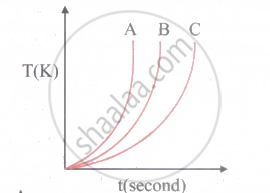
A geyser heats water flowing at a rate of 2.0 kg per minute from 30°C to 70°C. If the geyser operates on a gas burner, the rate of combustion of fuel will be ______ g min-1.
[Heat of combustion = 8 × 10³ Jg-1 Specific heat of water = 4.2 Jg-1°C-1]
Specific heat capacity of a substance X is 1900 Jkg-1°C-1 means ______.
Thermal capacities of substances A and B are same. If mass of A is more than mass of B then:
Which substance will have more specific heat capacity?
In the method of mixtures, a hot metal is dropped into cold water and the mixture reaches a final temperature. Which principle is used to find the specific heat of the metal?
