Advertisements
Advertisements
प्रश्न
Calculate the ratio of two specific heats of polyatomic gas molecules.
Advertisements
उत्तर
- Gases that have molecules containing more than two atoms are termed polyatomic gases.
- Each molecule of the polyatomic gas has 3 translational degrees of freedom. Only linear molecules have 2 degrees of freedom for rotation. All other polyatomic molecules have 3 degrees of freedom for rotation.
- The number of degrees of freedom (f) for the vibrational motion of a polyatomic molecule depends on the geometric structure of the molecule, i.e., the arrangement of atoms in a molecule.
- Each such degree of freedom contributes average energy `2 xx 1/2`kBT from kinetic energy and potential energy terms.
- Therefore for 1 mole of a polyatomic gas, the internal energy is E = `3/2 N_Ak_BT + 3/2 N_Ak_BT + f × 2/2 N_Ak_BT`
= (3 + f) NAkBT - Molar-specificific heats at constant volume and constant pressure are given as
Cv = (3 + f) R and Cp = (4 + f) R
∴ `gamma = C_p/C_v = (4 + f)/(3 + f)`
संबंधित प्रश्न
State two factors upon which the heat absorbed by a body depends
What property of water makes it an effective coolant?
Water in lakes and ponds do not freeze at once in cold countries. Give a reason is support of your answer.
Why do the farmers fill their fields with water on a cold winter night?
Give one example where high specific heat capacity of water is used as heat reservoir ?
What impact will climate changes have on the crops of food?
Fill in the following blank using suitable word:
SI unit of heat is .........
Specific heat capacity of a substance A is 3.8 J g-1 K-1 and of substance B is 0.4 J g-1 k-1. Which substance is a good conductor of heat? How did you arrive at your conclusion?
A liquid X has specific heat capacity higher than the liquid Y. Which liquid is useful as heat reservoir to keep juice bottles without freezing?
m kg of a substance of specific heat capacity s J/kg °C is heated so that its temperature rises from θ1°C to θ2°C. Write down the expression for the heat Q supplied.
Does the specific heat capacity of a substance depend upon its mass and rise in temperature only?
Write the approximate values of the specific latent heat of fusion of ice.
Write the approximate values of the specific latent heat of vaporization of steam.
Explain, why temperature in hot summer, falls sharply after a sharp shower?
Explain, Why is it advisabile to pour cold water over burns, caused on human body, by hot solids?
1 kg of water freezes to form ice at 0°C. What amount of heat is withdrawn?
A. hot solid of mass 60 g at 100°C is placed in 150 g of water at 20° C. The final steady temperature recorded is 25°C. Calculate the specific heat capacity of the solid. [Specific heat capacity of water = 4200 J kg-1 °C-1]
State factors on which the amount of heat radiated by a body depends.
What is specific heat capacity?
Numerical Problem.
What is the heat in joules required to raise the temperature of 25 grams of water from 0°C to 100°C? What is the heat in Calories? (Specific heat of water = `(4.18"J")/("g"°"C")`
If 'Cp' and 'Cv' are molar specific heats of an ideal gas at constant pressure and volume respectively. If 'λ' is the ratio of two specific heats and 'R' is universal gas constant then 'Cp' is equal to ______.
Heat is applied to a rigid diatomic gas at constant pressure. The ratio ΔQ : ΔU : ΔW is ______.
A metal ball of heat capacity 50J/°C loses 2000 J of heat. By how much will its temperature fall?
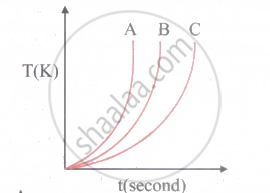
Which of the following substances (A, B and C) has the highest specific heat?
We would like to make a vessel whose volume does not change with temperature (take a hint from the problem above). We can use brass and iron `(β_(vbrass) = (6 xx 10^(–5))/K and β_(viron) = (3.55 xx 10^(–5))/K)` to create a volume of 100 cc. How do you think you can achieve this.
A block of ice of mass 120 g at temperature 0°C is put in 300 gm of water at 25°C. The xg of ice melts as the temperature of the water reaches 0°C. The value of x is ______.
[Use: Specific heat capacity of water = 4200 Jkg-1K-1, Latent heat of ice = 3.5 × 10⁵ Jkg-1]
Prove the Mayer's relation `C_p - C _v = R/J`
Calculate the amount of heat energy required to raise the temperature of 200 g of copper from 20°C to 70°C. Specific heat capacity of copper = 390 J kg-1 K-1.
