Advertisements
Advertisements
प्रश्न
Express the change in internal energy in terms of molar specific heat capacity.
Advertisements
उत्तर
When the gas is heated at constant volume the temperature increases by dT. As no work is done by the gas, the heat that flows into the system will increase only the internal energy. Let the change in internal energy be dU. dU = µωdT
APPEARS IN
संबंधित प्रश्न
Give one example where high specific heat capacity of water is used as heat reservoir ?
A mass m1 of a substance of specific heat capacity c1 at temperature t1 is mixed with a mass m2 of other substance of specific heat capacity c2 at a lower temperature t2. Deduce the expression for the temperature t of the mixture. State the assumption made, if any.
Explain the meaning of green house effect.
Name the radiations for which the green house gases are opaque ?
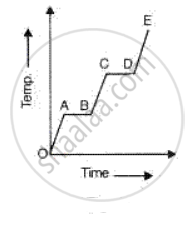
A substance is heated at a constant rate from a low temperature to a high temperature. A graph of temperature against time is shown in the figure. Which part or parts of the graph correspond(s) to the substance existing in two states?
(b) 2000 J of heat energy is required to raise the temperature of 4 kg of a
metal by 3°c. Which expression gives the specific heat capacity of the metal?
Specific heat capacity of a substance A is 3.8 J g-1 K-1 and of substance B is 0.4 J g-1 k-1. Which substance is a good conductor of heat? How did you arrive at your conclusion?
Water boils at 120 °C in a pressure cooker. Explain the reason.
All metals have the same specific heat capacity.
