Advertisements
Advertisements
प्रश्न
Derive Mayer’s relation.
Advertisements
उत्तर
- Consider one mole of an ideal gas that is enclosed in a cylinder by a light, frictionless airtight piston.
- Let P, V, and T be the pressure, volume, and temperature respectively of the gas.
- If the gas is heated so that its temperature rises by dT, but the volume remains constant, then the amount of heat supplied to the gas (dQ1) is used to increase the internal energy of the gas (dE). Since the volume of the gas is constant, no work is done in moving the piston.
∴ dQ1 = dE = CV dT ..............(1)
where CV is the molar specific heat of the gas at constant volume. - On the other hand, if the gas is heated to the same temperature, at constant pressure, the volume of the gas increases by an amount say dV. The amount of heat supplied to the gas is used to increase the internal energy of the gas as well as to move the piston backward to allow expansion of gas. The work is done to move the piston dW = PdV.
∴ dQ2 = dE + dW = Cp dT ..............(2)
Where CP is the molar specific heat of the gas at constant pressure. - From equations (1) and (2),
∴ Cp dT = CV dT + dW
∴ (Cp - Cv)dT = PdV ..............(3) - For one mole of gas,
PV = RT
∴ P dV = R dT, since pressure is constant.
Substituting equation (3), we get
(Cp - Cv) dT = R dT
∴ Cp - Cv = R
This is known as Mayer’s relation between CP and CV. - Also, CP = M0SP and CV = M0SV, where M0 is the molar mass of the gas and SP and SV are respective principal specific heats. Thus, M0SP - M0SV = R/J
Where J is the mechanical equivalent of heat.
SP - Sv = `"R"/("M"_0"J")`
संबंधित प्रश्न
What property of water makes it an effective coolant?
A solid metal weighing 150 g melts at its melting point of 800 °C by providing heat at the rate of 100 W. The time taken for it to completely melt at the same temperature is 4 min. What is the specific latent heat of fusion of the metal?
Heat supplied to a solid change it into liquid. What is this change in the phase called?
Name a liquid which has the highest specific heat capacity.
Water property of water makes it an effective coolant?
Give one example where high specific heat capacity of water is used as cooling purposes?
45 g of water at 50°C in a beaker is cooled when 50 g of copper at 18° C is added to it. The contents are stirred till a final constant temperature is reached. Calculate this final temperature. The specific heat capacity of copper is 0.39 J g-1K-1 and that of water is 4.2 J g-1K-1. State the assumption used.
It is generally cold after a hail-storm then during and before the hail storm. Give reason.
Explain the meaning of green house effect.
How will rise in sea level affect population in coastal countries?
State three ways to minimize the global warming.
A calorimeter has mass 100 g and specific heat 0.1 kcal/ kg°C. It contains 250 gm of liquid at 30°C having specific heat of 0.4 kcal/kg°C. If we drop a piece of ice of mass 10 g at 0°C, What will be the temperature of the mixture?
What is the specific heat capacity of melting ice?
Define the term 'specific heat capacity' and state its unit.
A substance is heated at a constant rate from a low temperature to a high temperature. A graph of temperature against time is shown in the figure. Which part or parts of the graph correspond(s) to the substance existing in two states?
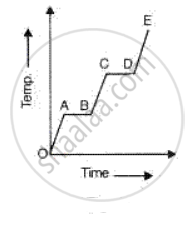
What change in heat energy occurs when lead at its melting point
solidifies without change in the temperature?
Write the approximate values of the specific latent heat of vaporization of steam.
A certain amount of heat Q will warm 1 g of material X by 3°C and 1 g of material Y by 4°C. Which material has a higher specific heat capacity?
If, in a central heating system, steam enters a radiation pipe at 100°C and water leaves the radiation pipe at 100°C, can this radiation pipe heat a room? Give an explanation for your answer.
How much heat energy is released when 5 g of water at 20° C changes to ice at 0° C?
[Specific heat capacity of water = 4.2 J g-1 ° C-1 Specific latent heat of fusion of ice = 336 J g-1]
A vessel of negligible heat*capacity contains 40g of ice in it at 0°C, 8g of steam at 100°C is passed into the ice to melt it. Find the final temperature of the contents of the vessel.
(Specific latent heat of vaporization of steam = 2268 J/g, specific latent heat of fusion of ice = 336 J/f and specific heat capacity of water = 4.2 J/g°C)
Derive an expression for finding out the specific heat capacity of a body (solid) from the readings of an experiment given below:
(i) Mass of empty calorimeter (with stirrer) = m1 gm
(ii) Mass of the metal piece = M gm
(iii) Mass of colorimeter and water = m2 gm
(iv) Initial temperature and water = t1°C
(v) Temperature of hot solid (metal piece) = t2 °C
(vi) Final temperature of the mixture = t°C
(vii) Specific heat of calorimeter = 0.4 J gm / °C
Solve the following problem.
Specific latent heat of vaporization of water is 2.26 × 10⁶ J/kg. Calculate the energy needed to change 5.0 g of water into steam at 100 ºC.
Read the passage and answer the questions based on it.
If heat is exchanged between a hot and cold object, the temperature of the cold object goes on increasing due to gain of energy and the temperature of the hot object goes on decreasing due to loss of energy. The change in temperature continues till the temperatures of both objects attain the same value. In this process, the cold object gains heat energy and the hot object loses heat energy. If the system of both the objects is isolated from the environment by keeping it inside a heat-resistant box then no energy can flow from inside the box or come into the box. In this situation, we get the following principle.
Heat energy lost by the hot object = Heat energy gained by the cold object. This is called the ‘Principle of heat exchange’.
- Where does heat transfer take place?
- In such a situation which principle of heat do you perceive?
- How can this principle be explained in short?
- Measuring the property of which substance this principle is used?
The heat capacity of the vessel of mass 100 kg is 8000 J/°K. Find its specific heat capacity.
The value of 'γ' for a gas is given as `gamma = 1 + 2/"f"`, where 'f ' is the number of degrees of freedom of freedom of a molecule of a gas. What is the ratio of `gamma_"monoatonic"//gamma_"diatomic"`?
Diatomic gas consists of rigid gas molecules
What is the amount of heat required to raise the temperature of 5 kg of iron from 30°C to 130°C? Specific heat capacity of iron = 483 Jkg-1C-1.
Thermal capacities of substances A and B are same. If mass of A is more than mass of B then:
Which substance will have more specific heat capacity?
