Advertisements
Advertisements
प्रश्न
Derive Mayer’s relation.
Advertisements
उत्तर
- Consider one mole of an ideal gas that is enclosed in a cylinder by a light, frictionless airtight piston.
- Let P, V, and T be the pressure, volume, and temperature respectively of the gas.
- If the gas is heated so that its temperature rises by dT, but the volume remains constant, then the amount of heat supplied to the gas (dQ1) is used to increase the internal energy of the gas (dE). Since the volume of the gas is constant, no work is done in moving the piston.
∴ dQ1 = dE = CV dT ..............(1)
where CV is the molar specific heat of the gas at constant volume. - On the other hand, if the gas is heated to the same temperature, at constant pressure, the volume of the gas increases by an amount say dV. The amount of heat supplied to the gas is used to increase the internal energy of the gas as well as to move the piston backward to allow expansion of gas. The work is done to move the piston dW = PdV.
∴ dQ2 = dE + dW = Cp dT ..............(2)
Where CP is the molar specific heat of the gas at constant pressure. - From equations (1) and (2),
∴ Cp dT = CV dT + dW
∴ (Cp - Cv)dT = PdV ..............(3) - For one mole of gas,
PV = RT
∴ P dV = R dT, since pressure is constant.
Substituting equation (3), we get
(Cp - Cv) dT = R dT
∴ Cp - Cv = R
This is known as Mayer’s relation between CP and CV. - Also, CP = M0SP and CV = M0SV, where M0 is the molar mass of the gas and SP and SV are respective principal specific heats. Thus, M0SP - M0SV = R/J
Where J is the mechanical equivalent of heat.
SP - Sv = `"R"/("M"_0"J")`
संबंधित प्रश्न
What do you understand by the following statements:
The heat capacity of the body is 60JK-1.
The temperature of 170 g of water at 50°C is lowered to 5°C by adding a certain amount of ice to it. Find the mass of ice added.
Given: Specific heat capacity of water = 4200 J kg-1 °C-1 and specific latent heat of ice = 336000 J kg-1.
Name the S.I. unit of heat.
The S.I. unit of specific heat capacity is ______.
The specific heat capacity of water is :
It is generally cold after a hail-storm then during and before the hail storm. Give reason.
How much heat energy is released when 5.0 g of water at 20℃ changes into ice at 0℃? Take specific heat capacity of water = 4.2 J g-1 K-1, Specific latent heat of fusion of ice = 336 J g-1.
Name three fossil fuels that emit carbon dioxide into the atmosphere ?
How does green house effect help in keeping the temperature of earth’s surface suitable for living of human beings?
How will global warming disturb the ecological balance?
State three ways to minimize the global warming.
Indian style of cooling drinking water is to keep it in a pitcher having porous walls. Water comes to the outer surface very slowly and evaporates. Most of energy needed for evaporation is taken from the water itself and the water is cooled down. Assume that a pitcher contains 10 kg of water and 0.2 g of water comes out per second. Assuming no backward heat transfer from the atmosphere to the water, calculate the time in which the temperature decrease by 5°C. Specific heat capacity of water = 4200 J kg−1 °C−1 and latent heat of vaporization of water = 2.27 × 10⁶ J kg−1.
Give one example where high specific heat capacity of water is used as cooling.
A burner raises the temperature of 360 g of water from 40°C to 100°C in 5 minutes. Calculate the rate of heat supplied by the burner.
State, with reason, which of the two, boiling water or steam both at 100°C will produce more severe burns.
Explain, why temperature in hot summer, falls sharply after a sharp shower?
Explain, why does a wise farmer water his fields, if forecast is forst?
Give two reasons as to why copper is preferred over other metals for making calorimeters.
A substance is in the form of a solid at 0°C. The amount of heat added to this substance and the temperature of the substance are plotted on the following graph:
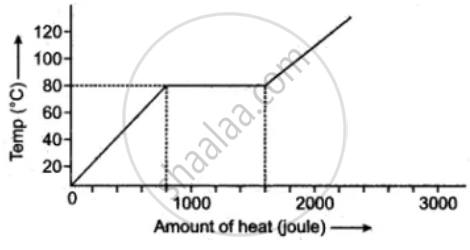
If the specific heat capacity of the solid substance is 500 J/kg °G, find from the graph, the mass of the substance.
A vessel of negligible heat*capacity contains 40g of ice in it at 0°C, 8g of steam at 100°C is passed into the ice to melt it. Find the final temperature of the contents of the vessel.
(Specific latent heat of vaporization of steam = 2268 J/g, specific latent heat of fusion of ice = 336 J/f and specific heat capacity of water = 4.2 J/g°C)
Solve the following problem.
What is the specific heat of metal if 50 cal of heat is needed to raise 6 kg of the metal from 20°C to 62 °C?
The heat capacity of the vessel of mass 100 kg is 8000 J/°K. Find its specific heat capacity.
An office room contains about 4000 moles of air. The change in the internal energy of this much air when it is cooled from 34° C to 19° C at a constant pressure of 1.0 atm is (Use `gamma_"air"` = 1.4 and Universal gas constant = 8.314 J / mol K) ____________.
Specific heat capacity C = ______.
The specific heat capacity of water is ______.
A geyser heats water flowing at a rate of 2.0 kg per minute from 30°C to 70°C. If the geyser operates on a gas burner, the rate of combustion of fuel will be ______ g min-1.
[Heat of combustion = 8 × 10³ Jg-1 Specific heat of water = 4.2 Jg-1°C-1]
Two blocks P and Q of different metals having their mass in the ratio 2 : 1 are given same amount of heat. Their temperature rises by same amount. Compare their specific heat capacities.
