Advertisements
Advertisements
प्रश्न
Advertisements
उत्तर
The specific heat capacity of water (4200 J Kg-1 K-1) is about five times as that of sand. Due to which water takes long time to get heated up and equally long time to get cooled. Thus, large temperature difference between the land and the sea causes formation of land and sea breezes.
APPEARS IN
संबंधित प्रश्न
What do you understand by the following statements:
The heat capacity of the body is 60JK-1.
A solid metal weighing 150 g melts at its melting point of 800 °C by providing heat at the rate of 100 W. The time taken for it to completely melt at the same temperature is 4 min. What is the specific latent heat of fusion of the metal?
Equal heat is given to two objects A and B of mass 1 g. Temperature of A increases by 3°C and B by 5°C. Which object has more specific heat? And by what factor?
What is the specific heat capacity of melting ice?
Define the term 'specific heat capacity' and state its unit.
Explain, why do sandy soils, get heated up quickly as compared to wet soils?
A vessel of negligible heat*capacity contains 40g of ice in it at 0°C, 8g of steam at 100°C is passed into the ice to melt it. Find the final temperature of the contents of the vessel.
(Specific latent heat of vaporization of steam = 2268 J/g, specific latent heat of fusion of ice = 336 J/f and specific heat capacity of water = 4.2 J/g°C)
The diagram below shows a cooling curve for 200 g of water. The heat is extracted at the rate of 100 Js-1. Answer the questions that follow:
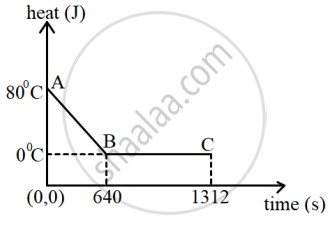
- Calculate specific heat capacity of water.
- Heat released in the region BC.
The specific heat capacity of ______ is maximum.
A geyser heats water flowing at a rate of 2.0 kg per minute from 30°C to 70°C. If the geyser operates on a gas burner, the rate of combustion of fuel will be ______ g min-1.
[Heat of combustion = 8 × 10³ Jg-1 Specific heat of water = 4.2 Jg-1°C-1]
