Advertisements
Advertisements
प्रश्न
The diagram below shows a cooling curve for 200 g of water. The heat is extracted at the rate of 100 Js-1. Answer the questions that follow:
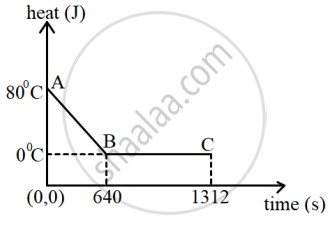
- Calculate specific heat capacity of water.
- Heat released in the region BC.
Advertisements
उत्तर
(a) mass of water (m) = 200 g = 0.2 kg.
Rate of heat extraction= 100 J/s.
So, total heat extracted for curve AB is = 100 × 640 = 64000 J
Now, for curve AB we can write,
64000 = 0.2 × Cp × (353 - 273) ...`[(80^circ "C" = 273 + 80 = 353;),(0^circ "C" = 273 + 0 = 273 "K")]`
Solving we get,
C = 4000 Jkg-1 K-1
Thus, the specific heat capacity of water is 4000 Jkg-1 K-1.
(b) From the figure it is clear that at point Band C is corresponds to time 640 sand 1312 s, respectively. Thus, heat released in region BC is = 100 × (1312 - 640) = 67,200 J
APPEARS IN
संबंधित प्रश्न
Study the following procedure and answer the questions below:
1. Take 3 spheres of iron, copper and lead of equal mass.
2. Put all the 3 spheres in boiling water in a beaker for some time.
3. Take 3 spheres out of the water. Put them immediately on a thick slab of wax.
4. Note, the depth that each sphere goes into the wax.
i) Which property of substance can be studied with this procedure?
ii) Describe that property in minimum words.
iii) Explain the rule of heat exchange with this property.
104g of water at 30°C is taken in a calorimeter made of copper of mass 42 g. When a certain mass of ice at 0°C is added to it, the final steady temperature of the mixture after the ice has melted, was found to be 10°C. Find the mass of ice added. [Specific heat capacity of water = 4.2 Jg–1°C–1 ; Specific latent heat of fusion of ice = 336 Jg–1; Specific heat capacity of copper = 0.4 Jg–1°C–1] .
m kg of a substance of specific heat capacity s J/kg °C is heated so that its temperature rises from θ1°C to θ2°C. Write down the expression for the heat Q supplied.
Explain, why water is considered as best liquid for quenching thirst?
A. hot solid of mass 60 g at 100°C is placed in 150 g of water at 20° C. The final steady temperature recorded is 25°C. Calculate the specific heat capacity of the solid. [Specific heat capacity of water = 4200 J kg-1 °C-1]
Solve the following problem.
What is the specific heat of metal if 50 cal of heat is needed to raise 6 kg of the metal from 20°C to 62 °C?
Numerical Problem.
How much heat energy is required to change 2 kg of ice at 0°C into water at 20°C? (Specific latent heat of fusion of water = 3,34,000 J/kg, Specific heat capacity of water = 4200 JKg–1K–1).
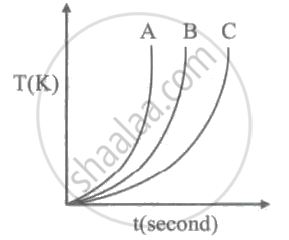
Which of the following substances (A, B and C) has the highest specific beat?
The molar specific heat of an ideal gas at constant pressure and constant volume is 'Cp' and 'Cv' respectively. If 'R' is the universal gas constant and the ratio 'Cp' to 'Cv' is 'γ' then CV = ______.
To study energy exchange between hot and cold objects, the system of both objects is isolated from the environment by keeping them inside ______.
