Advertisements
Advertisements
Question
The diagram below shows a cooling curve for 200 g of water. The heat is extracted at the rate of 100 Js-1. Answer the questions that follow:
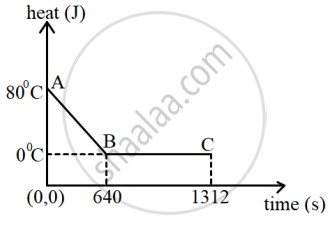
- Calculate specific heat capacity of water.
- Heat released in the region BC.
Advertisements
Solution
(a) mass of water (m) = 200 g = 0.2 kg.
Rate of heat extraction= 100 J/s.
So, total heat extracted for curve AB is = 100 × 640 = 64000 J
Now, for curve AB we can write,
64000 = 0.2 × Cp × (353 - 273) ...`[(80^circ "C" = 273 + 80 = 353;),(0^circ "C" = 273 + 0 = 273 "K")]`
Solving we get,
C = 4000 Jkg-1 K-1
Thus, the specific heat capacity of water is 4000 Jkg-1 K-1.
(b) From the figure it is clear that at point Band C is corresponds to time 640 sand 1312 s, respectively. Thus, heat released in region BC is = 100 × (1312 - 640) = 67,200 J
APPEARS IN
RELATED QUESTIONS
Name the radiations for which the green house gases are opaque ?
What is the specific heat capacity of melting ice?
Fill in the following blank using suitable word:
SI unit of heat is .........
What is heat? What is the S. I. unit of heat?
An equal quantity of heat is supplied to two substances A and B. The substance A shows a greater rise in temperature. What can you say about the heat capacity of A as compared to that of B?
1 kg of water freezes to form ice at 0°C. What amount of heat is withdrawn?
Calculate the amount of heat released when 5.0 g of water at 20°C is changed into ice at 0°C.
(Specific heat capacity of water = 4.2 J/g°C
Specific latent heat of fusion of ice = 336 J/g)
An electric immersion heater is rated 1250 W. Calculate the time in which it will heat 20 kg of water at 5°C to 65°C.
Write the name.
The amount of heat absorbed at constant temperature by unit mass of a liquid to convert into gaseous phase.
At same temperature and pressure of an ideal gas, ____________.
