Advertisements
Advertisements
Question
Derive Mayer’s relation.
Advertisements
Solution
- Consider one mole of an ideal gas that is enclosed in a cylinder by a light, frictionless airtight piston.
- Let P, V, and T be the pressure, volume, and temperature respectively of the gas.
- If the gas is heated so that its temperature rises by dT, but the volume remains constant, then the amount of heat supplied to the gas (dQ1) is used to increase the internal energy of the gas (dE). Since the volume of the gas is constant, no work is done in moving the piston.
∴ dQ1 = dE = CV dT ..............(1)
where CV is the molar specific heat of the gas at constant volume. - On the other hand, if the gas is heated to the same temperature, at constant pressure, the volume of the gas increases by an amount say dV. The amount of heat supplied to the gas is used to increase the internal energy of the gas as well as to move the piston backward to allow expansion of gas. The work is done to move the piston dW = PdV.
∴ dQ2 = dE + dW = Cp dT ..............(2)
Where CP is the molar specific heat of the gas at constant pressure. - From equations (1) and (2),
∴ Cp dT = CV dT + dW
∴ (Cp - Cv)dT = PdV ..............(3) - For one mole of gas,
PV = RT
∴ P dV = R dT, since pressure is constant.
Substituting equation (3), we get
(Cp - Cv) dT = R dT
∴ Cp - Cv = R
This is known as Mayer’s relation between CP and CV. - Also, CP = M0SP and CV = M0SV, where M0 is the molar mass of the gas and SP and SV are respective principal specific heats. Thus, M0SP - M0SV = R/J
Where J is the mechanical equivalent of heat.
SP - Sv = `"R"/("M"_0"J")`
RELATED QUESTIONS
In an experiment on the specific heat of a metal, a 0.20 kg block of the metal at 150 °C is dropped in a copper calorimeter (of water equivalent 0.025 kg) containing 150 cm3 of water at 27 °C. The final temperature is 40 °C. Compute the specific heat of the metal. If heat losses to the surroundings are not negligible, is your answer greater or smaller than the actual value for the specific heat of the metal?
Define heat capacity and state its SI unit.
A heater of power P watt raises the temperature of m kg of a liquid by Δt K in time t s. Express
the specific heat capacity of liquid in terms of above data.
Name two green house gases ?
Name three fossil fuels that emit carbon dioxide into the atmosphere ?
How will climate changes affect the various animal species?
How will global warming disturb the ecological balance?
Who shall pay carbon tax ?
The product of mass and specific heat is known as ..........
The substances like water which have ........... Heat capacity warm up more slowly than substances like iron which have .......... heat capacity.
650 J of heat is required to raise the temp. of 0.25 kg of lead from 15°C to 35°C. Calculate the Sp. heat capacity of lead.
If substances A and B are liquids then which one would be more useful in car radiators?
Given: Specific heat capacity’A’ 3.8 J/g /K. Specific heat capacity ‘B’ 0.4 J/g /K.
Calculate the amount of heat released when 5.0 g of water at 20°C is changed into ice at 0°C.
(Specific heat capacity of water = 4.2 J/g°C
Specific latent heat of fusion of ice = 336 J/g)
The heat capacity of the vessel of mass 100 kg is 8000 J/°K. Find its specific heat capacity.
Numerical Problem.
What could be the final temperature of a mixture of 100 g of water at 90 °C and 600g of water at 20°C.
If 'Cp' and 'Cv' are molar specific heats of an ideal gas at constant pressure and volume respectively. If 'λ' is the ratio of two specific heats and 'R' is universal gas constant then 'Cp' is equal to ______.
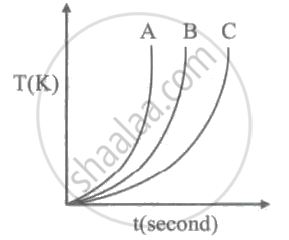
Which of the following substances (A, B and C) has the highest specific beat?
A monoatomic gas of pressure 'P' having volume 'V' expands isothermally to a volume '2V' and then adiabatically to a volume '16V'. The final pressure of the gas is ______.
(ratio of specific heats = `5/3`)
Heat is applied to a rigid diatomic gas at constant pressure. The ratio ΔQ : ΔU : ΔW is ______.
Why is water used as a coolant in radiators of a car?
Match the following
| 1. | Specific heat capacity | a. | Dewar bottle |
| 2. | Calorimeter | b. | Lavoisier and Simon |
| 3. | Vacuum flask | c. | J Kg-1 K-1 |
| 4. | Ice – calorimeter | d. | Heat capacity |
A metal ball of heat capacity 50J/°C loses 2000 J of heat. By how much will its temperature fall?
Match the columns:
| Column ‘A’ | Column ‘B’ |
| The SI unit of specific heat capacity | (a) Jkg−1°C−1 |
| (b) kg/m3 | |
| (c) calorie |
The difference between the two molar specific heats of gas is 9000 J/kg K. If the ratio of the two specific heats is 1.5, calculate the two molar specific heats.
Thermal capacities of substances A and B are same. If mass of A is more than mass of B then:
Which substance will have more specific heat capacity?
