Advertisements
Advertisements
Question
Explain, why does a wise farmer water his fields, if forecast is forst?
Advertisements
Solution
The frost can seriously damage the leaves and fruit of plants. When a farmer waters his fields, during, night, this water gives large amount of heat energy, because 1 g of water will liberate 4.2 J of energy for every 1°C fall in temperature. Thus, the air around the field is saturated with heat energy and its temperature does not fall below 0°C. Thus, no frost is formed.
RELATED QUESTIONS
A child running a temperature of 101°F is given an antipyrin (i.e. a medicine that lowers fever) which causes an increase in the rate of evaporation of sweat from his body. If the fever is brought down to 98 °F in 20 min, what is the average rate of extra evaporation caused, by the drug? Assume the evaporation mechanism to be the only way by which heat is lost. The mass of the child is 30 kg. The specific heat of human body is approximately the same as that of water, and latent heat of evaporation of water at that temperature is about 580 cal g–1.
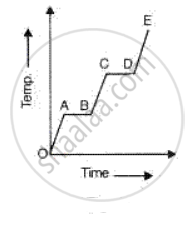
A substance is heated at a constant rate from a low temperature to a high temperature. A graph of temperature against time is shown in the figure. Which part or parts of the graph correspond(s) to the substance existing in two states?
Write two advantages of high specific heat capacity of water.
The temperature of a lead piece of mass 400 g rises from 20°C to 50°C when 1560 J of heat is supplied to it. Calculate Specific heat capacity of lead.
Answer the following question.
Why do we generally consider two specific heats of a gas?
Decide the unit for specific heat capacity.
The value of 'γ' for a gas is given as `gamma = 1 + 2/"f"`, where 'f ' is the number of degrees of freedom of freedom of a molecule of a gas. What is the ratio of `gamma_"monoatonic"//gamma_"diatomic"`?
Diatomic gas consists of rigid gas molecules
Two cylinders of equal height and radius are made of copper and aluminum. Which of them conducts heat faster?
The molar specific heats of an ideal gas at constant pressure and volume are denoted by Cp and Cv, respectively. If `gamma = "C"_"p"/"C"_"v"` and R is the universal gas constant, then Cv is equal to ______.
A 0.2 kg metal at 150°C is placed in a copper calorimeter (water equivalent 0.025 kg) with 150 cm³ water at 27°C. Final temperature is 40°C. Find the specific heat of the metal.
