Advertisements
Advertisements
प्रश्न
Explain, why does a wise farmer water his fields, if forecast is forst?
Advertisements
उत्तर
The frost can seriously damage the leaves and fruit of plants. When a farmer waters his fields, during, night, this water gives large amount of heat energy, because 1 g of water will liberate 4.2 J of energy for every 1°C fall in temperature. Thus, the air around the field is saturated with heat energy and its temperature does not fall below 0°C. Thus, no frost is formed.
संबंधित प्रश्न
A geyser heats water flowing at the rate of 3.0 litres per minute from 27 °C to 77 °C. If the geyser operates on a gas burner, what is the rate of consumption of the fuel if its heat of combustion is 4.0 × 10⁴ J/g?
A refrigerator converts 100 g of water at 20°C to ice at -10°C in 35 minutes. Calculate the average rate of heat extraction in terms of watts.
Given: Specific heat capacity of ice = 2.1 J g-1°C-1
Specific heat capacity of water = 4.2 J g-1°C-1
Specific latent heat of fusion of ice = 336 J g-1
Specific heat capacity of substance A is 3.8 J g-1K-1 whereas the specific heat capacity of substance B is 0.4 J g-1 K-1
(i) Which of the two is a good conductor of heat?
(ii) How is one led to the above conclusion?
(iii) If substances A and B are liquids then which one would be more useful in car radiators?
During the phase change does the average kinetic energy of the molecules of the substance increase?
State the impact of global warming on life on the earth.
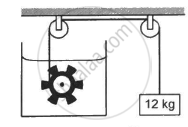
Figure shows a paddle wheel coupled to a mass of 12 kg through fixed frictionless pulleys. The paddle is immersed in a liquid of heat capacity 4200 J K−1 kept in an adiabatic container. Consider a time interval in which the 12 kg block falls slowly through 70 cm. (a) How much heat is given to the liquid? (b) How much work is done on the liquid? (c) Calculate the rise in the temperature of the liquid neglecting the heat capacity of the container and the paddle.
Give one example where high specific heat capacity of water is used as cooling.
Decide the unit for specific heat capacity.
The ratio of the specific heats `c_"p"/c_"v"=gamma` in terms of degrees of freedom 'n' is given by ______.
