Advertisements
Advertisements
प्रश्न
A solid metal weighing 150 g melts at its melting point of 800 °C by providing heat at the rate of 100 W. The time taken for it to completely melt at the same temperature is 4 min. What is the specific latent heat of fusion of the metal?
Advertisements
उत्तर
Given:
m = 150g = 150 × 10(-3) kg = 0.15 kg
Power (P) = 100W,
Time (t) = 4 min = 4 × 60 sec
The amount of heat supplied in 4 min
Heat energy (Q) = 100 × 4 × 60 = 24000 J
This heat energy is used in melting.
Let L be the latent specific heat.
∴ L = `"Q"/"m"`
∴ L = `24000/0.15`
= 1.6 × 10⁵ J kg-1
APPEARS IN
संबंधित प्रश्न
During the phase change does the average kinetic energy of the molecules of the substance increase?
Give a mathematical relation between Heat Capacity and Specific Heat Capacity.
Write the approximate value of specific heat capacity of water in S.I. unit.
Two metallic blocks P and Q of masses in ratio 2: 1 are given the same amount of heat. If their temperature rise by the same amount, compare their specific heat capacities.
Why do the farmers fill their fields with water on a cold winter night?
Water property of water makes it an effective coolant?
What is the specific heat capacity of melting ice?
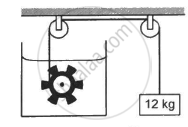
Figure shows a paddle wheel coupled to a mass of 12 kg through fixed frictionless pulleys. The paddle is immersed in a liquid of heat capacity 4200 J K−1 kept in an adiabatic container. Consider a time interval in which the 12 kg block falls slowly through 70 cm. (a) How much heat is given to the liquid? (b) How much work is done on the liquid? (c) Calculate the rise in the temperature of the liquid neglecting the heat capacity of the container and the paddle.
Calculate the amount of heat released when 5.0 g of water at 20°C is changed into ice at 0°C.
(Specific heat capacity of water = 4.2 J/g°C
Specific latent heat of fusion of ice = 336 J/g)
Match the following:
| Column A | Column B | ||
| 1. | Specific heat capacity of water | a. | 0°C |
| 2. | Latent heat of fusion of ice | b. | 2260 J/g |
| 3. | Latent heat of vaporization of water | c. | 100°C |
| 4. | The melting point of iced | d. | 4.2 J/g°C |
| 5. | The boiling point of water | e. | 336 J/g |
