Advertisements
Advertisements
Question
What amount of heat must be supplied to 2.0 x 10⁻² kg of nitrogen (at room temperature) to raise its temperature by 45 °C at constant pressure? (Molecular mass of N2 = 28; R = 8.3 J mol-1 K-1.)
Advertisements
Solution 1
Mass of nitrogen, m = 2.0 × 10⁻² kg = 20 g
Rise in temperature, ΔT = 45°C
Molecular mass of N2, M = 28
Universal gas constant, R = 8.3 J mol–1 K–1
Number of moles, `n = m/M`
`= (2.0xx10^(-2)xx10^3)/28 = 0.714`
Molar specific heat at constant pressure for nitrogen, `C_P = 7/2 R`
`= 7/2 xx 8.3`
`= 29.05 J mol^(-1) K^(-1)`
The total amount of heat to be supplied is given by the relation:
ΔQ = nCP ΔT
= 0.714 × 29.05 × 45
= 933.38 J
Therefore, the amount of heat to be supplied is 933.38 J.
Solution 2
Here, mass of gas,` m= 2xx 10^-2 kg` = 20 g
rise in temperature, `triangleT = 45 ^@C`
Heat required, triangleQ = ?, Molecular mass, M = 28
Number of moles , `n = m/M = 20/28 = 0.714`
As nitrogen is a diatomatic gas,molar specific heat at constant pressure is
`C_p = 7/2R = 7/2 xx 8.3 J mol^(-1) K^(-1)`
As `triangleQ = nC_p triangleT`
`:. triangleQ = 0.714 xx 7/2 xx 8.3 xx 45 J = 933.4 J`
APPEARS IN
RELATED QUESTIONS
In an experiment on the specific heat of a metal, a 0.20 kg block of the metal at 150 °C is dropped in a copper calorimeter (of water equivalent 0.025 kg) containing 150 cm3 of water at 27 °C. The final temperature is 40 °C. Compute the specific heat of the metal. If heat losses to the surroundings are not negligible, is your answer greater or smaller than the actual value for the specific heat of the metal?
Calculate the mass of ice needed to cool 150 g of water contained in a calorimeter of mass 50 g at 32 °C such that the final temperature is 5 °C. Specific heat capacity of calorimeter = 0.4 J g-1 °C-1, Specific heat capacity of water = 4.2 J g-1°C-1, latent heat capacity of ice = 330 J g-1.
Calculate the mass of ice required to lower the temperature of 300 g of water 40°C to water at 0°C.
(Specific latent heat of ice = 336 J/g, the Specific heat capacity of water = 4.2J/g°C)
What do you understand by the following statements:
The heat capacity of the body is 60JK-1.
Give a mathematical relation between Heat Capacity and Specific Heat Capacity.
Name the S.I. unit of heat.
Name a liquid which has the highest specific heat capacity.
What do you mean by the following statement?
The heat capacity of a body is 50 JK-1?
Discuss the role of high specific heat capacity of water with reference to climate in coastal areas.
Give one example where high specific heat capacity of water is used as heat reservoir ?
A mass m1 of a substance of specific heat capacity c1 at temperature t1 is mixed with a mass m2 of other substance of specific heat capacity c2 at a lower temperature t2. Deduce the expression for the temperature t of the mixture. State the assumption made, if any.
How much heat energy is released when 5.0 g of water at 20℃ changes into ice at 0℃? Take specific heat capacity of water = 4.2 J g-1 K-1, Specific latent heat of fusion of ice = 336 J g-1.
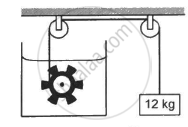
Figure shows a paddle wheel coupled to a mass of 12 kg through fixed frictionless pulleys. The paddle is immersed in a liquid of heat capacity 4200 J K−1 kept in an adiabatic container. Consider a time interval in which the 12 kg block falls slowly through 70 cm. (a) How much heat is given to the liquid? (b) How much work is done on the liquid? (c) Calculate the rise in the temperature of the liquid neglecting the heat capacity of the container and the paddle.
What change in heat energy occurs when lead at its melting point
solidifies without change in the temperature?
A piece of iron of mass 2.0 kg has a heat capacity of 966 J K-1. Find its specific heat capacity in S.I unit.
Explain, why is water sprayed on roads in evening in hot summer?
Explain, why do sandy soils, get heated up quickly as compared to wet soils?
Discuss how high specific heat capacity of water helps in formation of land and sea breeze.
A piece of ice is heated at a constant rate. The variation of temperature with heat input is shown in the graph below:

(i) What are represented by AB and CD?
(ii) What conclusion can you draw regarding the 110°c nature of ice from the above graph?
Derive an expression for finding out the specific heat capacity of a body (solid) from the readings of an experiment given below:
(i) Mass of empty calorimeter (with stirrer) = m1 gm
(ii) Mass of the metal piece = M gm
(iii) Mass of colorimeter and water = m2 gm
(iv) Initial temperature and water = t1°C
(v) Temperature of hot solid (metal piece) = t2 °C
(vi) Final temperature of the mixture = t°C
(vii) Specific heat of calorimeter = 0.4 J gm / °C
The specific heat capacity of water is 1 cal/g °C.
Numerical Problem.
What is the heat in joules required to raise the temperature of 25 grams of water from 0°C to 100°C? What is the heat in Calories? (Specific heat of water = `(4.18"J")/("g"°"C")`
The value of 'γ' for a gas is given as `gamma = 1 + 2/"f"`, where 'f ' is the number of degrees of freedom of freedom of a molecule of a gas. What is the ratio of `gamma_"monoatonic"//gamma_"diatomic"`?
Diatomic gas consists of rigid gas molecules
For a gas `"R"/"C"_"v" = 0.4,` where 'R' is the universal gas constant and 'Cv' is molar specific heat at constant volume. The gas is made up of molecules which are ______.
An office room contains about 4000 moles of air. The change in the internal energy of this much air when it is cooled from 34° C to 19° C at a constant pressure of 1.0 atm is (Use `gamma_"air"` = 1.4 and Universal gas constant = 8.314 J / mol K) ____________.
Two metals A and B have specific heat capacities in the ratio 2 : 3. If they are supplied the same amount of heat then
Which metal piece will show a greater rise in temperature given their masses is the same?
Specific heat capacity C = ______.
Match the following
| 1. | Specific heat capacity | a. | Dewar bottle |
| 2. | Calorimeter | b. | Lavoisier and Simon |
| 3. | Vacuum flask | c. | J Kg-1 K-1 |
| 4. | Ice – calorimeter | d. | Heat capacity |
Match the following:
| Column A | Column B | ||
| 1. | Specific heat capacity of water | a. | 0°C |
| 2. | Latent heat of fusion of ice | b. | 2260 J/g |
| 3. | Latent heat of vaporization of water | c. | 100°C |
| 4. | The melting point of iced | d. | 4.2 J/g°C |
| 5. | The boiling point of water | e. | 336 J/g |
Match the columns:
| Column ‘A’ | Column ‘B’ |
| The SI unit of specific heat capacity | (a) Jkg−1°C−1 |
| (b) kg/m3 | |
| (c) calorie |
The molar specific heats of an ideal gas at constant pressure and volume are denoted by Cp and Cv, respectively. If `gamma = "C"_"p"/"C"_"v"` and R is the universal gas constant, then Cv is equal to ______.
Two blocks P and Q of different metals having their mass in the ratio 2 : 1 are given same amount of heat. Their temperature rises by same amount. Compare their specific heat capacities.
Calculate the amount of heat energy required to raise the temperature of 200 g of copper from 20°C to 70°C. Specific heat capacity of copper = 390 J kg-1 K-1.
A mixture of one mole of monoatomic gas and one mole of a diatomic gas (rigid) are kept at room temperature (27°C). The ratio of specific heat of gases at constant volume respectively is:
