Advertisements
Advertisements
Question
Calculate the amount of heat energy required to raise the temperature of 200 g of copper from 20°C to 70°C. Specific heat capacity of copper = 390 J kg-1 K-1.
Advertisements
Solution
Mass of copper m = 200 g
= `200/1000`
= `2/10` kg
Rise in temperature Δ T = (70 - 20) = 50°C
Special heat capacity of copper = 390 J kg-1K-1
Amount of heat energy required Q = mc ΔT
Q = `2/10 xx 390 xx 50`
= 3900 J
APPEARS IN
RELATED QUESTIONS
What amount of heat must be supplied to 2.0 x 10⁻² kg of nitrogen (at room temperature) to raise its temperature by 45 °C at constant pressure? (Molecular mass of N2 = 28; R = 8.3 J mol-1 K-1.)
What do you mean by the following statement?
The heat capacity of a body is 50 JK-1?
What impact will global warming have on the health of the affected population?
Derive Meyer’s relation for an ideal gas.
Two uniform brass rods A and B of length land 2l and radii 2r and r respectively are heated to the same temperature. The ratio of the increase in the volume ofB to that of A is ____________.
A metal ball of heat capacity 50J/°C loses 2000 J of heat. By how much will its temperature fall?
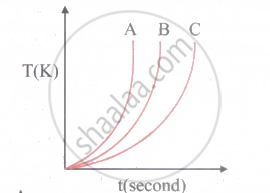
Which of the following substances (A, B and C) has the highest specific heat?