Advertisements
Advertisements
प्रश्न
What amount of heat must be supplied to 2.0 x 10⁻² kg of nitrogen (at room temperature) to raise its temperature by 45 °C at constant pressure? (Molecular mass of N2 = 28; R = 8.3 J mol-1 K-1.)
Advertisements
उत्तर १
Mass of nitrogen, m = 2.0 × 10⁻² kg = 20 g
Rise in temperature, ΔT = 45°C
Molecular mass of N2, M = 28
Universal gas constant, R = 8.3 J mol–1 K–1
Number of moles, `n = m/M`
`= (2.0xx10^(-2)xx10^3)/28 = 0.714`
Molar specific heat at constant pressure for nitrogen, `C_P = 7/2 R`
`= 7/2 xx 8.3`
`= 29.05 J mol^(-1) K^(-1)`
The total amount of heat to be supplied is given by the relation:
ΔQ = nCP ΔT
= 0.714 × 29.05 × 45
= 933.38 J
Therefore, the amount of heat to be supplied is 933.38 J.
उत्तर २
Here, mass of gas,` m= 2xx 10^-2 kg` = 20 g
rise in temperature, `triangleT = 45 ^@C`
Heat required, triangleQ = ?, Molecular mass, M = 28
Number of moles , `n = m/M = 20/28 = 0.714`
As nitrogen is a diatomatic gas,molar specific heat at constant pressure is
`C_p = 7/2R = 7/2 xx 8.3 J mol^(-1) K^(-1)`
As `triangleQ = nC_p triangleT`
`:. triangleQ = 0.714 xx 7/2 xx 8.3 xx 45 J = 933.4 J`
APPEARS IN
संबंधित प्रश्न
A solid of mass 50 g at 150 °C is placed in 100 g of water at 11 °C when the final temperature recorded is 20 °C. Find the specific heat capacity of the solid. (specific heat capacity of water = 4.2 J/g °C)
You have a choice of three metals A, B, and C, of specific heat capacities 900 Jkg-1 °C-1, 380 Jkg-1 °C-1 and 460 Jkg-1 °C-1 respectively, to make a calorimeter. Which material will you select? Justify your answer.
What do you understand by the following statements:
The specific heat capacity of lead is 130 Jkg-1K-1.
What property of water makes it an effective coolant?
Water in lakes and ponds do not freeze at once in cold countries. Give a reason is support of your answer.
During the phase change does the average kinetic energy of the molecules of the substance increase?
Discuss the role of high specific heat capacity of water with reference to climate in coastal areas.
Give one example where high specific heat capacity of water is used as cooling purposes?
A mass m1 of a substance of specific heat capacity c1 at temperature t1 is mixed with a mass m2 of other substance of specific heat capacity c2 at a lower temperature t2. Deduce the expression for the temperature t of the mixture. State the assumption made, if any.
Ice cream appears colder to the mouth than water at 0℃. Give reason.
Name two green house gases ?
Name the radiations for which the green house gases are transparent ?
How will rise in sea level affect population in coastal countries?
The global warming has resulted:
(a) the increase in yield of crops
(b) the decrease in sea levels
(c) the decrease in human deaths
(d) the increase in sea levels
(i) State whether the specific heat capacity of a substance remains the same when its state changes from solid to liquid.
(ii) Give one example to support your answer.
The substances like water which have ........... Heat capacity warm up more slowly than substances like iron which have .......... heat capacity.
(b) 2000 J of heat energy is required to raise the temperature of 4 kg of a
metal by 3°c. Which expression gives the specific heat capacity of the metal?
If 10125 J of heat energy boils off 4.5 g of water at 100°C to steam at 100°C, find the specific latent heat of steam.
Fill in the following blank using suitable word:
SI unit of heat is .........
A liquid X has specific heat capacity higher than the liquid Y. Which liquid is useful as heat reservoir to keep juice bottles without freezing?
Some heat is provided to a body to raise its temperature by 25°C. What will be the corresponding rise in temperature of the body as shown on the Kelvin scale?
Write an expression for the heat energy liberated by a hot body.
Will the value of specific heat’capacity and specific latent heat of a substance change if the scale is °F instead of °C?
A substance is in the form of a solid at 0°C. The amount of heat added to this substance and the temperature of the substance are plotted on the following graph:
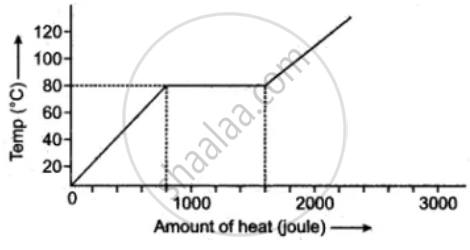
If the specific heat capacity of the solid substance is 500 J/kg °G, find from the graph, the mass of the substance.
How much heat energy is released when 5 g of water at 20° C changes to ice at 0° C?
[Specific heat capacity of water = 4.2 J g-1 ° C-1 Specific latent heat of fusion of ice = 336 J g-1]
A vessel of negligible heat*capacity contains 40g of ice in it at 0°C, 8g of steam at 100°C is passed into the ice to melt it. Find the final temperature of the contents of the vessel.
(Specific latent heat of vaporization of steam = 2268 J/g, specific latent heat of fusion of ice = 336 J/f and specific heat capacity of water = 4.2 J/g°C)
Consider the statement given below and choose the correct option.
Assertion: Radiation is a form of heat transfer which takes place only in vacuum.
Reason: The thermal energy is transferred from one part of a substance to another part without the actual movement of the atoms or molecules.
Numerical Problem.
What could be the final temperature of a mixture of 100 g of water at 90 °C and 600g of water at 20°C.
The molar specific heats of an ideal gas at constant pressure and constant volume are denoted by Cp and Cv respectively. If `gamma = "C"_"p"/"C"_"v"` and R is the universal gas constant, then Cp is equal to ______.
The specific heat capacity of water is ______.
Give one example where high specific heat capacity of water is used as heat reservoir.
Calculate the amount of heat energy required to raise the temperature of 200 g of copper from 20°C to 70°C. Specific heat capacity of copper = 390 J kg-1 K-1.
In the method of mixtures, a hot metal is dropped into cold water and the mixture reaches a final temperature. Which principle is used to find the specific heat of the metal?
