Advertisements
Advertisements
प्रश्न
An electric heater of power 600 W raises the temperature of 4.0 kg of a liquid from 10.0℃ to 15.0℃ in100 s. Calculate:
- the heat capacity of 4.0 kg of liquid,
- the specific heat capacity of the liquid.
Advertisements
उत्तर
Power of heater P = 600 W
t = 100 S
Mass of liquid m = 4.0 kg
Change in temperature of liquid = (15 − 10)°C = 5°C (or 5 K)
Time taken to raise its temperature = 100 s
(i) Heat capacity of liquid C' = `"Q"/(Δ"T")`
∴ C' = `60000/5`
= 12000 JK-1 or 1.2 × 10⁴ JK-1
(ii) Specific heat capacity of liquid C = ?
C = `"Q"/("m"Δ"T")`
= `60000/(4 xx 5)`
= 3 × 10³ J Kg-1°C-1
APPEARS IN
संबंधित प्रश्न
A heater of power P watt raises the temperature of m kg of a liquid by Δt K in time t s. Express
the specific heat capacity of liquid in terms of above data.
It is generally cold after a hail-storm then during and before the hail storm. Give reason.
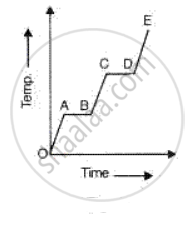
A substance is heated at a constant rate from a low temperature to a high temperature. A graph of temperature against time is shown in the figure. Which part or parts of the graph correspond(s) to the substance existing in two states?
Fill in the following blank using suitable word:
SI unit of heat is .........
The farmers fill their fields with water in winter. Give reason.
Why is specific heat capacity taken as a measure of thermal inertia?
Is it possible to condense the water formed, back to ice by adding ice at 0°C. Explain with reason.
What is specific heat capacity?
On supplying 100 µC of charge to a conductor, its potential rises by 5 V then capacity of the conductor is ______.
A mixture of one mole of monoatomic gas and one mole of a diatomic gas (rigid) are kept at room temperature (27°C). The ratio of specific heat of gases at constant volume respectively is:
