Advertisements
Advertisements
प्रश्न
Find the time taken by a 500 W heater to raise the temperature of 50 kg of material of specific heat capacity 960 J kg-1K-1, from 18°C to 38° C. Assume that all the heat energy supplied by the heater is given to the material.
Advertisements
उत्तर
Power of heater (P) = 500 W
mass of material (m) = 50 kg
Specific heat capacity of material c = 960 J kg-1K-1
Change in temperature ΔT = (38 − 18)°C = 20°C (or 20 K)
ΔQ = mcΔT
ΔQ = 50 × 960 × 20
Time taken by a heater to raise the temperature of material
`"t" = (Δ"Q")/ "P" `
`"t" = (50 xx 960 xx 20)/ 500`
t = 1920 seconds
t = 32 min
APPEARS IN
संबंधित प्रश्न
You have a choice of three metals A, B, and C, of specific heat capacities 900 Jkg-1 °C-1, 380 Jkg-1 °C-1 and 460 Jkg-1 °C-1 respectively, to make a calorimeter. Which material will you select? Justify your answer.
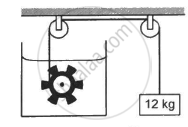
Figure shows a paddle wheel coupled to a mass of 12 kg through fixed frictionless pulleys. The paddle is immersed in a liquid of heat capacity 4200 J K−1 kept in an adiabatic container. Consider a time interval in which the 12 kg block falls slowly through 70 cm. (a) How much heat is given to the liquid? (b) How much work is done on the liquid? (c) Calculate the rise in the temperature of the liquid neglecting the heat capacity of the container and the paddle.
A piece of iron of mass 2.0 kg has a heat capacity of 966 J K-1. Find its specific heat capacity in S.I unit.
What are other units of heat? Name and define them.
The molar specific heat of a gas at constant volume is 12307.69 J kg-1 K-1. If the ratio of the two specific heats is 1.65, calculate the difference between the two molar specific heats of gas.
Two metals A and B have specific heat capacities in the ratio 2:3. If they are supplied same amount of heat then
Which metal piece will have greater mass if the rise in temperature is the same for both metals?
Why is water used as a coolant in radiators of a car?
Match the columns:
| Column ‘A’ | Column ‘B’ |
| The SI unit of specific heat capacity | (a) Jkg−1°C−1 |
| (b) kg/m3 | |
| (c) calorie |
