Advertisements
Advertisements
प्रश्न
What do you understand by the following statements:
The heat capacity of the body is 60JK-1.
Advertisements
उत्तर
Heat capacity is the amount of heat required to raise the temperature of a body by 1°C or 1 K. Thus, 60 JK−1 of energy is required to raise the temperature of the given body by 1 K.
APPEARS IN
संबंधित प्रश्न
A heater of power P watt raises the temperature of m kg of a liquid by Δt K in time t s. Express
the specific heat capacity of liquid in terms of above data.
Explain the term boiling point ?
What is heat? What is the S. I. unit of heat?
Some heat is provided to a body to raise its temperature by 25°C. What will be the corresponding rise in temperature of the body as shown on the Kelvin scale?
An electric immersion heater is rated 1250 W. Calculate the time in which it will heat 20 kg of water at 5°C to 65°C.
Solve the following problem.
What is the specific heat of metal if 50 cal of heat is needed to raise 6 kg of the metal from 20°C to 62 °C?
_______ is defined as the amount of heat required to raise the temperature of 1kg of a substance by 1°C.
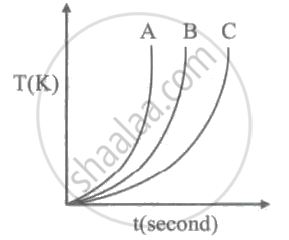
Which of the following substances (A, B and C) has the highest specific beat?
An office room contains about 4000 moles of air. The change in the internal energy of this much air when it is cooled from 34° C to 19° C at a constant pressure of 1.0 atm is (Use `gamma_"air"` = 1.4 and Universal gas constant = 8.314 J / mol K) ____________.
A metal ball of heat capacity 50J/°C loses 2000 J of heat. By how much will its temperature fall?
