Advertisements
Advertisements
प्रश्न
What is specific heat capacity?
Advertisements
उत्तर
- The specific heat capacity of a substance is defined as the amount of heat required to raise the temperature of 1 kg of the substance by 1°C or 1 K.
- Q = mC∆T, where Q is the quantity of heat required to raise the temperature and m is the mass of the body and AT is the change in temperature of the body.
- The SI unit of specific heat capacity is Jkg– 1 K– 1. The most commonly used units of specific heat capacity are J/kg°C and J/g°C.
APPEARS IN
संबंधित प्रश्न
Differentiate between heat capacity and specific heat capacity.
Write the approximate value of specific heat capacity of water in S.I. unit.
A liquid X has specific heat capacity higher than the liquid Y. Which liquid is useful as coolant in car radiators.
Explain, why is water sprayed on roads in evening in hot summer?
A substance is in the form of a solid at 0°C. The amount of heat added to this substance and the temperature of the substance are plotted on the following graph:
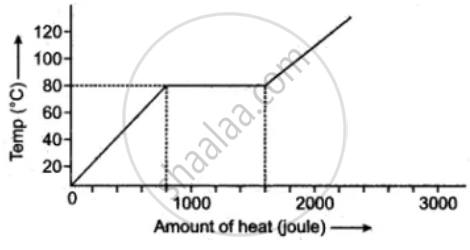
If the specific heat capacity of the solid substance is 500 J/kg °G, find from the graph, the mass of the substance.
From the options given below the specific heat of _______ is maximum.
If 'Cp' and 'Cv' are molar specific heats of an ideal gas at constant pressure and volume respectively. If 'λ' is the ratio of two specific heats and 'R' is universal gas constant then 'Cp' is equal to ______.
The specific heat capacity of ______ is maximum.
The molar specific heats of an ideal gas at constant pressure and volume are denoted by Cp and Cv, respectively. If `gamma = "C"_"p"/"C"_"v"` and R is the universal gas constant, then Cv is equal to ______.
Two blocks P and Q of different metals having their mass in the ratio 2 : 1 are given same amount of heat. Their temperature rises by same amount. Compare their specific heat capacities.
