Advertisements
Advertisements
प्रश्न
If substances A and B are liquids then which one would be more useful in car radiators?
Given: Specific heat capacity’A’ 3.8 J/g /K. Specific heat capacity ‘B’ 0.4 J/g /K.
Advertisements
उत्तर
‘A’ which has more specific heat will be preferable for car radiators as it will act as coolant.
संबंधित प्रश्न
Specific heat capacity of substance A is 3.8 J g-1K-1 whereas the specific heat capacity of substance B is 0.4 J g-1 K-1
(i) Which of the two is a good conductor of heat?
(ii) How is one led to the above conclusion?
(iii) If substances A and B are liquids then which one would be more useful in car radiators?
What impact will global warming have on the health of the affected population?
What is the specific heat capacity of melting ice?
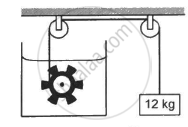
Figure shows a paddle wheel coupled to a mass of 12 kg through fixed frictionless pulleys. The paddle is immersed in a liquid of heat capacity 4200 J K−1 kept in an adiabatic container. Consider a time interval in which the 12 kg block falls slowly through 70 cm. (a) How much heat is given to the liquid? (b) How much work is done on the liquid? (c) Calculate the rise in the temperature of the liquid neglecting the heat capacity of the container and the paddle.
Define heat capacity.
Will the value of specific heat’capacity and specific latent heat of a substance change if the scale is °F instead of °C?
A piece of lead weighing 500 g gives out 1200 calories of heat when it is cooled from 100° C to 20° C. Find its specific heat.
Two metals A and B have specific heat capacities in the ratio 2:3. If they are supplied same amount of heat then
If the mass ratio of metal A and metal B is 3:5 then calculate the ratio in which their temperatures rise.
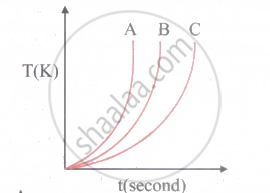
Which of the following substances (A, B and C) has the highest specific heat?
In the method of mixtures, a hot metal is dropped into cold water and the mixture reaches a final temperature. Which principle is used to find the specific heat of the metal?
