Advertisements
Advertisements
प्रश्न
Define heat capacity.
Define the term ‘heat capacity’.
Advertisements
उत्तर
The heat capacity of a body is the quantity of heat required to raise its temperature by 1°C. It depends upon the mass and the nature of the body.
संबंधित प्रश्न
The temperature of 170 g of water at 50°C is lowered to 5°C by adding a certain amount of ice to it. Find the mass of ice added.
Given: Specific heat capacity of water = 4200 J kg-1 °C-1 and specific latent heat of ice = 336000 J kg-1.
What do you mean by the following statement?
The specific heat capacity of copper is 0. 4 Jg-1 K-1?
An electric heater of power 600 W raises the temperature of 4.0 kg of a liquid from 10.0℃ to 15.0℃ in100 s. Calculate:
- the heat capacity of 4.0 kg of liquid,
- the specific heat capacity of the liquid.
How will rise in sea level affect population in coastal countries?
650 J of heat is required to raise the temp. of 0.25 kg of lead from 15°C to 35°C. Calculate the Sp. heat capacity of lead.
A piece of ice is heated at a constant rate. The variation of temperature with heat input is shown in the graph below:

(i) What are represented by AB and CD?
(ii) What conclusion can you draw regarding the 110°c nature of ice from the above graph?
The temperature of a lead piece of mass 400 g rises from 20°C to 50°C when 1560 J of heat is supplied to it. Calculate Specific heat capacity of lead.
The heat capacity of the vessel of mass 100 kg is 8000 J/°K. Find its specific heat capacity.
The diagram below shows a cooling curve for 200 g of water. The heat is extracted at the rate of 100 Js-1. Answer the questions that follow:
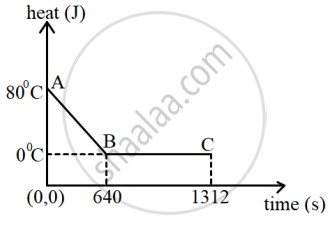
- Calculate specific heat capacity of water.
- Heat released in the region BC.
