Advertisements
Advertisements
Questions
Define heat capacity.
Define the term ‘heat capacity’.
Advertisements
Solution
The heat capacity of a body is the quantity of heat required to raise its temperature by 1°C. It depends upon the mass and the nature of the body.
RELATED QUESTIONS
A child running a temperature of 101°F is given an antipyrin (i.e. a medicine that lowers fever) which causes an increase in the rate of evaporation of sweat from his body. If the fever is brought down to 98 °F in 20 min, what is the average rate of extra evaporation caused, by the drug? Assume the evaporation mechanism to be the only way by which heat is lost. The mass of the child is 30 kg. The specific heat of human body is approximately the same as that of water, and latent heat of evaporation of water at that temperature is about 580 cal g–1.
Heat supplied to a solid change it into liquid. What is this change in the phase called?
State, with reason, which of the two, boiling water or steam both at 100°C will produce more severe burns.
If, in a central heating system, steam enters a radiation pipe at 100°C and water leaves the radiation pipe at 100°C, can this radiation pipe heat a room? Give an explanation for your answer.
A substance is in the form of a solid at 0°C. The amount of heat added to this substance and the temperature of the substance are plotted on the following graph:
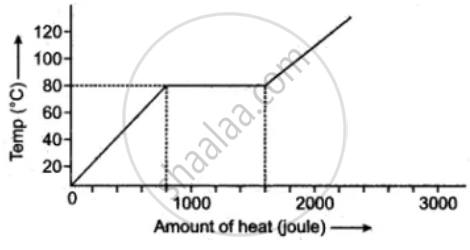
If the specific heat capacity of the solid substance is 500 J/kg °G, find from the graph, the mass of the substance.
The SI unit of specific heat is _______.
Conductors have generally high specific heat capacities and insulators have low specific heat capacities.
A metal ball of heat capacity 50J/°C loses 2000 J of heat. By how much will its temperature fall?
Observe the following diagram and answer the questions given below:

Specific heat capacity of metals
- Which element has maximum specific heat capacity? Justify.
- Which element has minimum specific heat capacity? Justify.
- Define specific heat of object.
Give one example where high specific heat capacity of water is used as heat reservoir.
