Advertisements
Advertisements
प्रश्न
Read this activity and answer the following questions.
- Take three spheres of iron, copper and lead. the lead of equal mass.
- Put all the three spheres in boiling water in the beaker for some time.
- Take the three spheres out of the water.
- All the spheres will be at a temperature 100 °C.
- Put them immediately on the thick slab of wax.
- Note, the depth that each of the sphere goes into the wax.
Questions:
- Which property is determined from this activity?
- Give name to that property.
- Explain the term principal of heat exchange with the help of this activity.
Advertisements
उत्तर
- Property which determines the amount of heat absorbed by a sphere is different for the three spheres is ascertain from this activity.
- This property is called the specific heat capacity.
- The sphere that absorbs more heat from water supplies more heat to wax causing more melting of wax and going deeper in wax obeying the principle of heat exchange which states that; In an isolated system, Heat lost by hot object = Heat gained by cold object.
APPEARS IN
संबंधित प्रश्न
What do you understand by the following statements:
The specific heat capacity of lead is 130 Jkg-1K-1.
State two factors upon which the heat absorbed by a body depends
Describe a method to determine the specific heat capacity of a solid, like a piece of copper ?
Explain the term boiling point ?
What is meant by specific heat capacity?
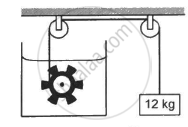
Figure shows a paddle wheel coupled to a mass of 12 kg through fixed frictionless pulleys. The paddle is immersed in a liquid of heat capacity 4200 J K−1 kept in an adiabatic container. Consider a time interval in which the 12 kg block falls slowly through 70 cm. (a) How much heat is given to the liquid? (b) How much work is done on the liquid? (c) Calculate the rise in the temperature of the liquid neglecting the heat capacity of the container and the paddle.
(i) State whether the specific heat capacity of a substance remains the same when its state changes from solid to liquid.
(ii) Give one example to support your answer.
State the condition for the flow of heat energy from one body to another.
Name the substance which has maximum specific heat capacity.
Give two reasons as to why copper is preferred over other metals for making calorimeters.
If, in a central heating system, steam enters a radiation pipe at 100°C and water leaves the radiation pipe at 100°C, can this radiation pipe heat a room? Give an explanation for your answer.
Why are athletes advised to put on extra clothes after competing on event?
An electric immersion heater is rated 1250 W. Calculate the time in which it will heat 20 kg of water at 5°C to 65°C.
Derive an expression for finding out the specific heat capacity of a body (solid) from the readings of an experiment given below:
(i) Mass of empty calorimeter (with stirrer) = m1 gm
(ii) Mass of the metal piece = M gm
(iii) Mass of colorimeter and water = m2 gm
(iv) Initial temperature and water = t1°C
(v) Temperature of hot solid (metal piece) = t2 °C
(vi) Final temperature of the mixture = t°C
(vii) Specific heat of calorimeter = 0.4 J gm / °C
Solve the following problem.
Specific latent heat of vaporization of water is 2.26 × 10⁶ J/kg. Calculate the energy needed to change 5.0 g of water into steam at 100 ºC.
The heat capacity of the vessel of mass 100 kg is 8000 J/°K. Find its specific heat capacity.
Observe the following diagram and answer the questions given below:

Specific heat capacity of metals
- Which element has maximum specific heat capacity? Justify.
- Which element has minimum specific heat capacity? Justify.
- Define specific heat of object.
