Advertisements
Advertisements
प्रश्न
Why are athletes advised to put on extra clothes after competing on event?
Advertisements
उत्तर
Athletes perspire profusely after competing in an event. The latent heat of evaporation of the ‘sweat’ is withdrawn from the body itself and therefore, cools the body. Hence, if they do not put on extra clothes, they are likely to catch cold.
संबंधित प्रश्न
In an experiment on the specific heat of a metal, a 0.20 kg block of the metal at 150 °C is dropped in a copper calorimeter (of water equivalent 0.025 kg) containing 150 cm3 of water at 27 °C. The final temperature is 40 °C. Compute the specific heat of the metal. If heat losses to the surroundings are not negligible, is your answer greater or smaller than the actual value for the specific heat of the metal?
Differentiate between heat capacity and specific heat capacity.
Explain the term boiling point ?
Name the radiations for which the green house gases are opaque ?
What is the unit of heat capacity in CGS system?
Explain, why do sandy soils, get heated up quickly as compared to wet soils?
Derive an expression for finding out the specific heat capacity of a body (solid) from the readings of an experiment given below:
(i) Mass of empty calorimeter (with stirrer) = m1 gm
(ii) Mass of the metal piece = M gm
(iii) Mass of colorimeter and water = m2 gm
(iv) Initial temperature and water = t1°C
(v) Temperature of hot solid (metal piece) = t2 °C
(vi) Final temperature of the mixture = t°C
(vii) Specific heat of calorimeter = 0.4 J gm / °C
How much heat energy is necessary to raise the temperature of 5 kg of water from 20°C to 100°C?
The diagram below shows a cooling curve for 200 g of water. The heat is extracted at the rate of 100 Js-1. Answer the questions that follow:
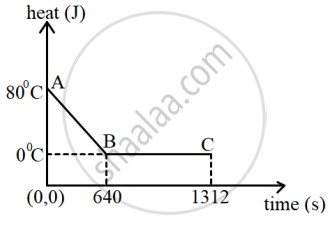
- Calculate specific heat capacity of water.
- Heat released in the region BC.
The specific heat capacity of ______ is maximum.
