Advertisements
Advertisements
प्रश्न
Write two advantages of high specific heat capacity of water.
Advertisements
उत्तर
(i) Water is used as an effective coolant in radiator of a car.
(ii) Hot water bottles are used for fomentation.
संबंधित प्रश्न
Equal heat is given to two objects A and B of mass 1 g. Temperature of A increases by 3°C and B by 5°C. Which object has more specific heat? And by what factor?
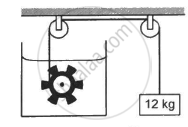
Figure shows a paddle wheel coupled to a mass of 12 kg through fixed frictionless pulleys. The paddle is immersed in a liquid of heat capacity 4200 J K−1 kept in an adiabatic container. Consider a time interval in which the 12 kg block falls slowly through 70 cm. (a) How much heat is given to the liquid? (b) How much work is done on the liquid? (c) Calculate the rise in the temperature of the liquid neglecting the heat capacity of the container and the paddle.
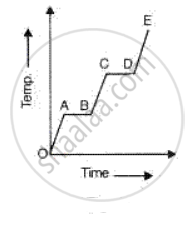
A substance is heated at a constant rate from a low temperature to a high temperature. A graph of temperature against time is shown in the figure. Which part or parts of the graph correspond(s) to the substance existing in two states?
An electric immersion heater is rated 1250 W. Calculate the time in which it will heat 20 kg of water at 5°C to 65°C.
From the options given below the specific heat of _______ is maximum.
The heat capacity of the vessel of mass 100 kg is 8000 J/°K. Find its specific heat capacity.
Numerical Problem.
How much heat energy is required to change 2 kg of ice at 0°C into water at 20°C? (Specific latent heat of fusion of water = 3,34,000 J/kg, Specific heat capacity of water = 4200 JKg–1K–1).
J/Kg °C is the unit of specific heat capacity.
To study energy exchange between hot and cold objects, the system of both objects is isolated from the environment by keeping them inside ______.
The difference between the two molar specific heats of gas is 9000 J/kg K. If the ratio of the two specific heats is 1.5, calculate the two molar specific heats.
