Advertisements
Advertisements
प्रश्न
Why is specific heat capacity taken as a measure of thermal inertia?
Advertisements
उत्तर
We have H = ms Δθ or Δθ = (H/ms).
It follows that if s is more, Δθ will be small (for given values of H and m). Thus, for a given body, its specific heat capacity determines the change in temperature produced by a given quantity of heat. It is thus like mass in mechanics which determines the change in velocity (or the acceleration) produced by a given force. It is quite appropriate, therefore, to regard specific heat capacity as a measure of thermal inertia.
संबंधित प्रश्न
Water in lakes and ponds do not freeze at once in cold countries. Give a reason is support of your answer.
A liquid X has the maximum specific heat capacity and is used as a coolant in Car Radiators. Name the liquid X.
Name the S.I. unit of heat.
What do you mean by the following statement?
The heat capacity of a body is 50 JK-1?
What impact will global warming have on the health of the affected population?
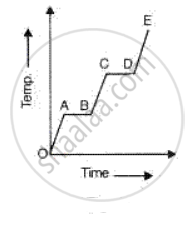
A substance is heated at a constant rate from a low temperature to a high temperature. A graph of temperature against time is shown in the figure. Which part or parts of the graph correspond(s) to the substance existing in two states?
(b) 2000 J of heat energy is required to raise the temperature of 4 kg of a
metal by 3°c. Which expression gives the specific heat capacity of the metal?
A vessel of negligible heat*capacity contains 40g of ice in it at 0°C, 8g of steam at 100°C is passed into the ice to melt it. Find the final temperature of the contents of the vessel.
(Specific latent heat of vaporization of steam = 2268 J/g, specific latent heat of fusion of ice = 336 J/f and specific heat capacity of water = 4.2 J/g°C)
A monoatomic gas of pressure 'P' having volume 'V' expands isothermally to a volume '2V' and then adiabatically to a volume '16V'. The final pressure of the gas is ______.
(ratio of specific heats = `5/3`)
