Advertisements
Advertisements
प्रश्न
Advertisements
उत्तर
Pressure cooker increases the pressure and hence the boiling point increases. So, the boiling point becomes greater than 100°C.
APPEARS IN
संबंधित प्रश्न
What amount of heat must be supplied to 2.0 x 10⁻² kg of nitrogen (at room temperature) to raise its temperature by 45 °C at constant pressure? (Molecular mass of N2 = 28; R = 8.3 J mol-1 K-1.)
You have a choice of three metals A, B, and C, of specific heat capacities 900 Jkg-1 °C-1, 380 Jkg-1 °C-1 and 460 Jkg-1 °C-1 respectively, to make a calorimeter. Which material will you select? Justify your answer.
In Regnault's apparatus for measuring specific heat capacity of a solid, there is an inlet and an outlet in the steam chamber. The inlet is near the top and the outlet is near the bottom. Why is it better than the opposite choice where the inlet is near the bottom and the outlet is near the top?
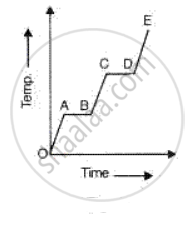
A substance is heated at a constant rate from a low temperature to a high temperature. A graph of temperature against time is shown in the figure. Which part or parts of the graph correspond(s) to the substance existing in two states?
A piece of iron of mass 2.0 kg has a heat capacity of 966 J K-1. Find its specific heat capacity in S.I unit.
State the condition for the flow of heat energy from one body to another.
m kg of a substance of specific heat capacity s J/kg °C is heated so that its temperature rises from θ1°C to θ2°C. Write down the expression for the heat Q supplied.
At same temperature and pressure of an ideal gas, ____________.
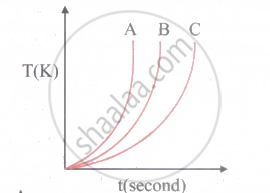
Which of the following substances (A, B and C) has the highest specific heat?