Advertisements
Advertisements
प्रश्न
In Regnault's apparatus for measuring specific heat capacity of a solid, there is an inlet and an outlet in the steam chamber. The inlet is near the top and the outlet is near the bottom. Why is it better than the opposite choice where the inlet is near the bottom and the outlet is near the top?
Advertisements
उत्तर
The inlet is near the top and the outlet is near the bottom because there is a loss of heat from the steam as it passes through the chamber. As the steam loses heat, a part of it condenses back to water and the cold steam gets denser and moves down towards the bottom.
But when done the other way round, the used steam does not pass through the chamber correctly and gets mixed up. This can result in discrepancy in the desired results.
APPEARS IN
संबंधित प्रश्न
Heat energy is supplied at a constant rate to 100g of ice at 0 °C. The ice is converted into water at 0° C in 2 minutes. How much time will be required to raise the temperature of water from 0 °C to 20 °C? [Given: sp. heat capacity of water = 4.2 J g-1 °C-1, sp. latent heat of ice = 336 J g-1].
Heat supplied to a solid change it into liquid. What is this change in the phase called?
Name the S.I. unit of heat.
Water is used in hot water bottles for fomentation. Give a reason.
The S.I. unit of specific heat capacity is ______.
Explain the term boiling ?
Why do bottled soft drinks get cooled, more quickly by the ice cubes than by the iced water, both at 0℃?
Explain the meaning of green house effect.
How does green house effect help in keeping the temperature of earth’s surface suitable for living of human beings?
State the effect of enhancement of green house effect.
What impact will global warming have on the health of the affected population?
What impact will climate changes have on the crops of food?
The global warming has resulted:
(a) the increase in yield of crops
(b) the decrease in sea levels
(c) the decrease in human deaths
(d) the increase in sea levels
(i) State whether the specific heat capacity of a substance remains the same when its state changes from solid to liquid.
(ii) Give one example to support your answer.
Define the term 'specific heat capacity' and state its unit.
A substance is heated at a constant rate from a low temperature to a high temperature. A graph of temperature against time is shown in the figure. Which part or parts of the graph correspond(s) to the substance existing in two states?
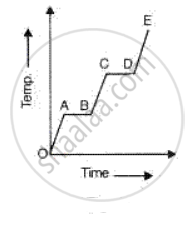
What change in heat energy occurs when lead at its melting point
solidifies without change in the temperature?
A piece of iron of mass 2.0 kg has a heat capacity of 966 J K-1. Find its specific heat capacity in S.I unit.
What are the factors on which the quantity of heat given to a body depends?
Name the substance which has maximum specific heat capacity.
Specific heat capacity of substance A is 3.8 J g-1 K-1whereas the specific heat capacity of substance B is 0.4 J g-1 K-1. Which of the two is a good conductor of heat? How is one led to this conclusion?
Is it possible to condense the water formed, back to ice by adding ice at 0°C. Explain with reason.
How much heat energy is necessary to raise the temperature of 5 kg of water from 20°C to 100°C?
The SI unit of specific heat is _______.
Numerical Problem.
How much heat energy is required to change 2 kg of ice at 0°C into water at 20°C? (Specific latent heat of fusion of water = 3,34,000 J/kg, Specific heat capacity of water = 4200 JKg–1K–1).
A diatomic gas undergoes adiabatic change. Its pressure 'P' and temperature 'T' are related as p ∝ Tx, where x is ______.
Heat is applied to a rigid diatomic gas at constant pressure. The ratio ΔQ : ΔU : ΔW is ______.
Two metals A and B have specific heat capacities in the ratio 2 : 3. If they are supplied the same amount of heat then
Which metal piece will show a greater rise in temperature given their masses is the same?
Two metals A and B have specific heat capacities in the ratio 2:3. If they are supplied same amount of heat then
If specific heat capacity of metal A is 0.26 Jg-1 0C-1 then calculate the specific heat capacity of metal B.
J/Kg °C is the unit of specific heat capacity.
Match the following
| 1. | Specific heat capacity | a. | Dewar bottle |
| 2. | Calorimeter | b. | Lavoisier and Simon |
| 3. | Vacuum flask | c. | J Kg-1 K-1 |
| 4. | Ice – calorimeter | d. | Heat capacity |
We would like to make a vessel whose volume does not change with temperature (take a hint from the problem above). We can use brass and iron `(β_(vbrass) = (6 xx 10^(–5))/K and β_(viron) = (3.55 xx 10^(–5))/K)` to create a volume of 100 cc. How do you think you can achieve this.
The specific heat capacity of ______ is maximum.
In the method of mixtures, a hot metal is dropped into cold water and the mixture reaches a final temperature. Which principle is used to find the specific heat of the metal?
