Advertisements
Advertisements
प्रश्न
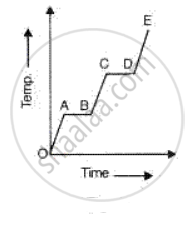
A substance is heated at a constant rate from a low temperature to a high temperature. A graph of temperature against time is shown in the figure. Which part or parts of the graph correspond(s) to the substance existing in two states?
Advertisements
उत्तर
APPEARS IN
संबंधित प्रश्न
What do you understand by the following statements:
The specific heat capacity of lead is 130 Jkg-1K-1.
A mass m1 of a substance of specific heat capacity c1 at temperature t1 is mixed with a mass m2 of other substance of specific heat capacity c2 at a lower temperature t2. Deduce the expression for the temperature t of the mixture. State the assumption made, if any.
Name three fossil fuels that emit carbon dioxide into the atmosphere ?
State the condition for the flow of heat energy from one body to another.
Answer the following question.
Why do we generally consider two specific heats of a gas?
Define specific heat capacity.
What is specific heat capacity?
The ratio of the specific heats `c_"p"/c_"v"=gamma` in terms of degrees of freedom 'n' is given by ______.
Specific heat capacity C = ______.
A 0.2 kg metal at 150°C is placed in a copper calorimeter (water equivalent 0.025 kg) with 150 cm³ water at 27°C. Final temperature is 40°C. Find the specific heat of the metal.
