Advertisements
Advertisements
प्रश्न
Numerical Problem.
What could be the final temperature of a mixture of 100 g of water at 90 °C and 600g of water at 20°C.
Advertisements
उत्तर
To find final temperature: ∆Q = mc
lOOg of water originally at 90°C will loose an amount of heat,
∆Q = mc ∆T
∆Q = 100 × c × (90 – T)
The same amount of heat will be absorbed by 600g of water originally at 20°C to raise its temperature to T.
∆Q = 600 × c × (T – 30)
600C (T – 20°) = 100C (90° – T)
6T – 120° = 90° – T
6T + T = 120° + 90°
7T = 210° ⇒ T = 210/7
T = 30°C
APPEARS IN
संबंधित प्रश्न
What do you mean by the following statement?
The specific heat capacity of copper is 0. 4 Jg-1 K-1?
Explain the meaning of green house effect.
How will rise in sea level affect population in coastal countries?
What is meant by specific heat capacity?
Study the following procedure and answer the questions below:
1. Take 3 spheres of iron, copper and lead of equal mass.
2. Put all the 3 spheres in boiling water in a beaker for some time.
3. Take 3 spheres out of the water. Put them immediately on a thick slab of wax.
4. Note, the depth that each sphere goes into the wax.
i) Which property of substance can be studied with this procedure?
ii) Describe that property in minimum words.
iii) Explain the rule of heat exchange with this property.
The specific heat capacity of a body depends on _____________ .
A substance is heated at a constant rate from a low temperature to a high temperature. A graph of temperature against time is shown in the figure. Which part or parts of the graph correspond(s) to the substance existing in two states?
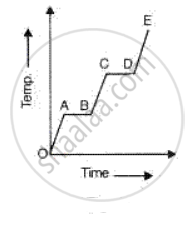
What are the factors on which the quantity of heat given to a body depends?
Why is specific heat capacity taken as a measure of thermal inertia?
A piece of iron of mass 2.0 kg has a thermal capacity of 966 J/°C. What is its specific heat capacity in S.I. units?
