Advertisements
Advertisements
प्रश्न
Numerical Problem.
How much heat energy is required to change 2 kg of ice at 0°C into water at 20°C? (Specific latent heat of fusion of water = 3,34,000 J/kg, Specific heat capacity of water = 4200 JKg–1K–1).
Advertisements
उत्तर
Total heat = Heat required to convert 2Kg of ice into water at 0°C + Heat required to convert 2Kg of water at 0°C to 2Kg of water at 20°C
Heat = m (hfw) + mc∆T
Here, m(mass of ice) = 2Kg
hfw (specific latent heat of water) = 3,34,000J/Kg
C (specific heat capacity of water) = 4200JKg– 1K– 1
AT (Temperature difference) = 20°C
Therefore, Heat required = (2 × 334000) + (2 × 4200) (20 – 0)
= 668000 + 8400 (20)
= 668000+ 168000
Heat required = 8,36,000 J
APPEARS IN
संबंधित प्रश्न
Explain, why water is considered as best liquid for quenching thirst?
Why are athletes advised to put on extra clothes after competing on event?
A substance is in the form of a solid at 0°C. The amount of heat added to this substance and the temperature of the substance are plotted on the following graph:
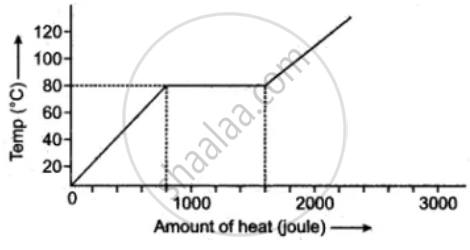
If the specific heat capacity of the solid substance is 500 J/kg °G, find from the graph, the mass of the substance.
A vessel of negligible heat*capacity contains 40g of ice in it at 0°C, 8g of steam at 100°C is passed into the ice to melt it. Find the final temperature of the contents of the vessel.
(Specific latent heat of vaporization of steam = 2268 J/g, specific latent heat of fusion of ice = 336 J/f and specific heat capacity of water = 4.2 J/g°C)
Write a short note.
Specific heat capacity
Explain how heat capacity of a solid can be determined by the method of mixture.
Read this activity and answer the following questions.
- Take three spheres of iron, copper and lead. the lead of equal mass.
- Put all the three spheres in boiling water in the beaker for some time.
- Take the three spheres out of the water.
- All the spheres will be at a temperature 100 °C.
- Put them immediately on the thick slab of wax.
- Note, the depth that each of the sphere goes into the wax.
Questions:
- Which property is determined from this activity?
- Give name to that property.
- Explain the term principal of heat exchange with the help of this activity.
The heat capacity of the vessel of mass 100 kg is 8000 J/°K. Find its specific heat capacity.
Match the columns:
| Column ‘A’ | Column ‘B’ |
| The SI unit of specific heat capacity | (a) Jkg−1°C−1 |
| (b) kg/m3 | |
| (c) calorie |
Calculate the amount of heat energy required to raise the temperature of 200 g of copper from 20°C to 70°C. Specific heat capacity of copper = 390 J kg-1 K-1.
