Advertisements
Advertisements
प्रश्न
Given below are observations on molar specific heats at room temperature of some common gases.
| Gas |
Molar specific heat (Cv) (cal mol–1 K–1) |
| Hydrogen | 4.87 |
| Nitrogen | 4.97 |
| Oxygen | 5.02 |
| Nitric oxide | 4.99 |
| Carbon monoxide | 5.01 |
| Chlorine | 6.17 |
The measured molar specific heats of these gases are markedly different from those for monatomic gases. Typically, molar specific heat of a monatomic gas is 2.92 cal/mol K. Explain this difference. What can you infer from the somewhat larger (than the rest) value for chlorine?
Advertisements
उत्तर १
The gases listed in the given table are diatomic. Besides the translational degree of freedom, they have other degrees of freedom (modes of motion).
Heat must be supplied to increase the temperature of these gases. This increases the average energy of all the modes of motion. Hence, the molar specific heat of diatomic gases is more than that of monatomic gases.
If only rotational mode of motion is considered, then the molar specific heat of a diatomic gas = `5/2 R`
= 5/2 xx 1.98 =4.95 `"cal mol"^(-1) K^(-1)`
With the exception of chlorine, all the observations in the given table agree with (`5/2R`). This is because at room temperature, chlorine also has vibrational modes of motion besides rotational and translational modes of motion.
उत्तर २
The gases which are listed in the above table are diatomic gases and not mono atomic gases. For diatomic gases, molar specific heat =5/2 R = 5/2 x 1.98 = 4.95, which agrees fairly well with all observations listed in the table except for chlorine. A mono atomic gas molecule has only the translational motion. A diatomic gas molecule, apart from translational motion, the vibrational as well as rotational motion is also possible. Therefore, to raise the temperature of 1 mole of a diatomic gas through 1°C, heat is to be supplied to increase not only translational energy but also rotational and vibrational energies. Hence, molar specific heat of a diatomic gas is greater than that for mono atomic gas. The higher value of molar specific heat of chlorine as compared to hydrogen, nitrogen, oxygen etc. shows that for chlorine molecule, at room temperature vibrational motion also occurs along with translational and rotational motions, whereas other diatomic molecules at room temperature usually have rotational motion apart from their translational motion. This is the reason that chlorine has somewhat larger value of molar specific heat.
APPEARS IN
संबंधित प्रश्न
A child running a temperature of 101°F is given an antipyrin (i.e. a medicine that lowers fever) which causes an increase in the rate of evaporation of sweat from his body. If the fever is brought down to 98 °F in 20 min, what is the average rate of extra evaporation caused, by the drug? Assume the evaporation mechanism to be the only way by which heat is lost. The mass of the child is 30 kg. The specific heat of human body is approximately the same as that of water, and latent heat of evaporation of water at that temperature is about 580 cal g–1.
What amount of heat must be supplied to 2.0 x 10⁻² kg of nitrogen (at room temperature) to raise its temperature by 45 °C at constant pressure? (Molecular mass of N2 = 28; R = 8.3 J mol-1 K-1.)
A solid of mass 50 g at 150 °C is placed in 100 g of water at 11 °C when the final temperature recorded is 20 °C. Find the specific heat capacity of the solid. (specific heat capacity of water = 4.2 J/g °C)
Calculate the mass of ice required to lower the temperature of 300 g of water 40°C to water at 0°C.
(Specific latent heat of ice = 336 J/g, the Specific heat capacity of water = 4.2J/g°C)
Explain the term boiling point ?
Name the radiations for which the green house gases are transparent ?
How will climate changes affect the various animal species?
State three ways to minimize the global warming.
What is carbon tax?
What is meant by specific heat capacity?
How will you prove experimentally that different substances have different specific heat capacities?
Indian style of cooling drinking water is to keep it in a pitcher having porous walls. Water comes to the outer surface very slowly and evaporates. Most of energy needed for evaporation is taken from the water itself and the water is cooled down. Assume that a pitcher contains 10 kg of water and 0.2 g of water comes out per second. Assuming no backward heat transfer from the atmosphere to the water, calculate the time in which the temperature decrease by 5°C. Specific heat capacity of water = 4200 J kg−1 °C−1 and latent heat of vaporization of water = 2.27 × 10⁶ J kg−1.
Define the term 'specific heat capacity' and state its unit.
A burner raises the temperature of 360 g of water from 40°C to 100°C in 5 minutes. Calculate the rate of heat supplied by the burner.
A solid of mass 80 g at 80°C is dropped in 400 g water at 10°C. If final temp. is 30°C, find the sp. heat cap. of the solid.
If substances A and B are liquids then which one would be more useful in car radiators?
Given: Specific heat capacity’A’ 3.8 J/g /K. Specific heat capacity ‘B’ 0.4 J/g /K.
From the options given below the specific heat of _______ is maximum.
The SI unit of specific heat is _______.
Explain how heat capacity of a solid can be determined by the method of mixture.
_______ is defined as the amount of heat required to raise the temperature of 1kg of a substance by 1°C.
When a uniform rod is heated, which of the following quantity of the rod will increase
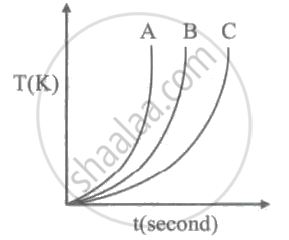
Which of the following substances (A, B and C) has the highest specific beat?
A monoatomic gas of pressure 'P' having volume 'V' expands isothermally to a volume '2V' and then adiabatically to a volume '16V'. The final pressure of the gas is ______.
(ratio of specific heats = `5/3`)
The value of 'γ' for a gas is given as `gamma = 1 + 2/"f"`, where 'f ' is the number of degrees of freedom of freedom of a molecule of a gas. What is the ratio of `gamma_"monoatonic"//gamma_"diatomic"`?
Diatomic gas consists of rigid gas molecules
An office room contains about 4000 moles of air. The change in the internal energy of this much air when it is cooled from 34° C to 19° C at a constant pressure of 1.0 atm is (Use `gamma_"air"` = 1.4 and Universal gas constant = 8.314 J / mol K) ____________.
Two metals A and B have specific heat capacities in the ratio 2:3. If they are supplied same amount of heat then
Which metal piece will have greater mass if the rise in temperature is the same for both metals?
Specific heat capacity C = ______.
The specific heat capacity of water is ______.
Two blocks P and Q of different metals having their mass in the ratio 2 : 1 are given same amount of heat. Their temperature rises by same amount. Compare their specific heat capacities.
Calculate the amount of heat energy required to raise the temperature of 200 g of copper from 20°C to 70°C. Specific heat capacity of copper = 390 J kg-1 K-1.
In the method of mixtures, a hot metal is dropped into cold water and the mixture reaches a final temperature. Which principle is used to find the specific heat of the metal?
