Advertisements
Advertisements
Question
Given below are observations on molar specific heats at room temperature of some common gases.
| Gas |
Molar specific heat (Cv) (cal mol–1 K–1) |
| Hydrogen | 4.87 |
| Nitrogen | 4.97 |
| Oxygen | 5.02 |
| Nitric oxide | 4.99 |
| Carbon monoxide | 5.01 |
| Chlorine | 6.17 |
The measured molar specific heats of these gases are markedly different from those for monatomic gases. Typically, molar specific heat of a monatomic gas is 2.92 cal/mol K. Explain this difference. What can you infer from the somewhat larger (than the rest) value for chlorine?
Advertisements
Solution 1
The gases listed in the given table are diatomic. Besides the translational degree of freedom, they have other degrees of freedom (modes of motion).
Heat must be supplied to increase the temperature of these gases. This increases the average energy of all the modes of motion. Hence, the molar specific heat of diatomic gases is more than that of monatomic gases.
If only rotational mode of motion is considered, then the molar specific heat of a diatomic gas = `5/2 R`
= 5/2 xx 1.98 =4.95 `"cal mol"^(-1) K^(-1)`
With the exception of chlorine, all the observations in the given table agree with (`5/2R`). This is because at room temperature, chlorine also has vibrational modes of motion besides rotational and translational modes of motion.
Solution 2
The gases which are listed in the above table are diatomic gases and not mono atomic gases. For diatomic gases, molar specific heat =5/2 R = 5/2 x 1.98 = 4.95, which agrees fairly well with all observations listed in the table except for chlorine. A mono atomic gas molecule has only the translational motion. A diatomic gas molecule, apart from translational motion, the vibrational as well as rotational motion is also possible. Therefore, to raise the temperature of 1 mole of a diatomic gas through 1°C, heat is to be supplied to increase not only translational energy but also rotational and vibrational energies. Hence, molar specific heat of a diatomic gas is greater than that for mono atomic gas. The higher value of molar specific heat of chlorine as compared to hydrogen, nitrogen, oxygen etc. shows that for chlorine molecule, at room temperature vibrational motion also occurs along with translational and rotational motions, whereas other diatomic molecules at room temperature usually have rotational motion apart from their translational motion. This is the reason that chlorine has somewhat larger value of molar specific heat.
APPEARS IN
RELATED QUESTIONS
In an experiment on the specific heat of a metal, a 0.20 kg block of the metal at 150 °C is dropped in a copper calorimeter (of water equivalent 0.025 kg) containing 150 cm3 of water at 27 °C. The final temperature is 40 °C. Compute the specific heat of the metal. If heat losses to the surroundings are not negligible, is your answer greater or smaller than the actual value for the specific heat of the metal?
Water in lakes and ponds do not freeze at once in cold countries. Give a reason is support of your answer.
Water property of water makes it an effective coolant?
A heater of power P watt raises the temperature of m kg of a liquid by Δt K in time t s. Express
the specific heat capacity of liquid in terms of above data.
Name three fossil fuels that emit carbon dioxide into the atmosphere ?
What impact will climate changes have on the crops of food?
Equal heat is given to two objects A and B of mass 1 g. Temperature of A increases by 3°C and B by 5°C. Which object has more specific heat? And by what factor?
What is the specific heat capacity of boiling water?
The product of mass and specific heat is known as ..........
Water boils at 120 °C in a pressure cooker. Explain the reason.
What are other units of heat? Name and define them.
Write the approximate values of the specific latent heat of fusion of ice.
The farmers fill their fields with water in winter. Give reason.
Is it possible to condense the water formed, back to ice by adding ice at 0°C. Explain with reason.
Describe a method to determine the specific heat capacity of a solid (say, a piece of copper).
Will the value of specific heat’capacity and specific latent heat of a substance change if the scale is °F instead of °C?
The temperature of a lead piece of mass 400 g rises from 20°C to 50°C when 1560 J of heat is supplied to it. Calculate: Heat capacity of lead piece.
Solve the following problem.
Specific latent heat of vaporization of water is 2.26 × 10⁶ J/kg. Calculate the energy needed to change 5.0 g of water into steam at 100 ºC.
The molar specific heat of a gas at constant volume is 12307.69 J kg-1 K-1. If the ratio of the two specific heats is 1.65, calculate the difference between the two molar specific heats of gas.
How much heat energy is necessary to raise the temperature of 5 kg of water from 20°C to 100°C?
The SI unit of specific heat is _______.
The specific heat capacity of water is 1 cal/g °C.
Read the passage and answer the questions based on it.
If heat is exchanged between a hot and cold object, the temperature of the cold object goes on increasing due to gain of energy and the temperature of the hot object goes on decreasing due to loss of energy. The change in temperature continues till the temperatures of both objects attain the same value. In this process, the cold object gains heat energy and the hot object loses heat energy. If the system of both the objects is isolated from the environment by keeping it inside a heat-resistant box then no energy can flow from inside the box or come into the box. In this situation, we get the following principle.
Heat energy lost by the hot object = Heat energy gained by the cold object. This is called the ‘Principle of heat exchange’.
- Where does heat transfer take place?
- In such a situation which principle of heat do you perceive?
- How can this principle be explained in short?
- Measuring the property of which substance this principle is used?
Consider the statement given below and choose the correct option.
Assertion: Radiation is a form of heat transfer which takes place only in vacuum.
Reason: The thermal energy is transferred from one part of a substance to another part without the actual movement of the atoms or molecules.
Numerical Problem.
What is the heat in joules required to raise the temperature of 25 grams of water from 0°C to 100°C? What is the heat in Calories? (Specific heat of water = `(4.18"J")/("g"°"C")`
Numerical Problem.
What could be the final temperature of a mixture of 100 g of water at 90 °C and 600g of water at 20°C.
Numerical Problem.
How much heat energy is required to change 2 kg of ice at 0°C into water at 20°C? (Specific latent heat of fusion of water = 3,34,000 J/kg, Specific heat capacity of water = 4200 JKg–1K–1).
A diatomic gas undergoes adiabatic change. Its pressure 'P' and temperature 'T' are related as p ∝ Tx, where x is ______.
Two uniform brass rods A and B of length land 2l and radii 2r and r respectively are heated to the same temperature. The ratio of the increase in the volume ofB to that of A is ____________.
The value of 'γ' for a gas is given as `gamma = 1 + 2/"f"`, where 'f ' is the number of degrees of freedom of freedom of a molecule of a gas. What is the ratio of `gamma_"monoatonic"//gamma_"diatomic"`?
Diatomic gas consists of rigid gas molecules
At same temperature and pressure of an ideal gas, ____________.
Water has the lowest specific heat capacity.
Match the following
| 1. | Specific heat capacity | a. | Dewar bottle |
| 2. | Calorimeter | b. | Lavoisier and Simon |
| 3. | Vacuum flask | c. | J Kg-1 K-1 |
| 4. | Ice – calorimeter | d. | Heat capacity |
Which of the following substances (A, B and C) has the highest specific heat?
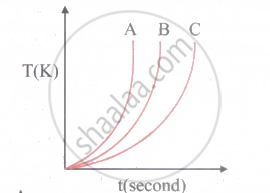
To study energy exchange between hot and cold objects, the system of both objects is isolated from the environment by keeping them inside ______.
The difference between the two molar specific heats of gas is 9000 J/kg K. If the ratio of the two specific heats is 1.5, calculate the two molar specific heats.
A geyser heats water flowing at a rate of 2.0 kg per minute from 30°C to 70°C. If the geyser operates on a gas burner, the rate of combustion of fuel will be ______ g min-1.
[Heat of combustion = 8 × 10³ Jg-1 Specific heat of water = 4.2 Jg-1°C-1]
A 0.2 kg metal at 150°C is placed in a copper calorimeter (water equivalent 0.025 kg) with 150 cm³ water at 27°C. Final temperature is 40°C. Find the specific heat of the metal.
