Advertisements
Advertisements
Question
Derive Meyer’s relation for an ideal gas.
Advertisements
Solution
Meyer’s relation: Consider p mole of an ideal gas in a container with volume V, pressure P and temperature T.
When the gas is heated at constant volume the temperature increases by dT. As no work is done by the gas, the heat that flows into the system will increase only the internal energy. Let the change in internal energy be dU.
If Cv is the molar specific heat capacity at constant volume, from the equation.
`"C"_"v" = 1/µ "dU"/"dT"` ..........(1)
dU = µCvdT .........(2)
Suppose the gas is heated at constant pressure so that the temperature increases by dT. If ‘Q’ is the heat supplied in this process and ‘dV’ the change in volume of the gas.
Q = µCPdT …............(3)
If W is the work done by the gas in this process, then
W = PdV …................(4)
But from the first law of thermodynamics,
Q = dU + W …...............(5)
Substituting equations (2), (3) and (4) in (5), we get,
µCpdT = µCvdT + PdV
For mole of an ideal gas, the equation of state is given by
PV = µRT ⇒ PdV + VdP = µRdT
Since the pressure is constant, dP = 0
∴ CpdT = CvdT + RdT
∴ CP = Cv +R (or) Cp − Cv = R ......(6)
This relation is called Meyer’s relation It implies that the molar specific heat capacity of an ideal gas at constant pressure is greater than molar specific heat capacity at constant volume. The relation shows that specific heat at constant pressure (sp) is always greater than specific heat at constant volume (sv).
APPEARS IN
RELATED QUESTIONS
Given below are observations on molar specific heats at room temperature of some common gases.
| Gas |
Molar specific heat (Cv) (cal mol–1 K–1) |
| Hydrogen | 4.87 |
| Nitrogen | 4.97 |
| Oxygen | 5.02 |
| Nitric oxide | 4.99 |
| Carbon monoxide | 5.01 |
| Chlorine | 6.17 |
The measured molar specific heats of these gases are markedly different from those for monatomic gases. Typically, molar specific heat of a monatomic gas is 2.92 cal/mol K. Explain this difference. What can you infer from the somewhat larger (than the rest) value for chlorine?
What do you understand by the following statements:
The specific heat capacity of lead is 130 Jkg-1K-1.
Discuss the role of high specific heat capacity of water with reference to climate in coastal areas.
Explain the meaning of green house effect.
Name and state the principle used to measure the specific heat capacity of a substance.
Explain, why is water sprayed on roads in evening in hot summer?
Write an expression for the heat energy liberated by a hot body.
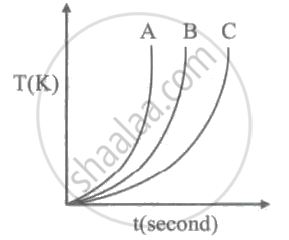
Which of the following substances (A, B and C) has the highest specific beat?
Find the odd one out:
