Advertisements
Advertisements
Question
Explain in detail the isothermal process.
Advertisements
Solution
Isothermal process: It is a process in which the temperature remains constant but the pressure and volume of a thermodynamic system will change. The ideal gas equation is
PV = µRT
Here, T is constant for this process So the equation of state for the isothermal process is given by
PV = Constant ..................…(1)
This implies that if the gas goes from one equilibrium state (P1, V1) to another equilibrium state (P2, V2) the following relation holds for this process
P1V1 = P2V2 ….............(2)
Since PV = constant, P is inversely proportional to `"V" ("P" ∝ 1/"V")`. This implies that the PV graph is a hyperbola. The pressure-volume graph for constant temperature is also called isotherm. We know that for an ideal gas the internal energy is a function of temperature only. For an isothermal process since the temperature is constant, the internal energy is also constant. This implies that dU or ∆U = 0.
For an isothermal process, the first law of thermodynamics can be written as,
Q = W …...........(3)
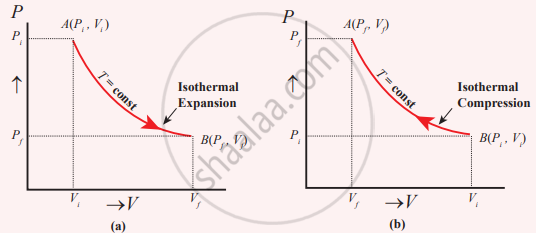
(a) Quasi-static isothermal expansion (b) Quasi-static isothermal compression
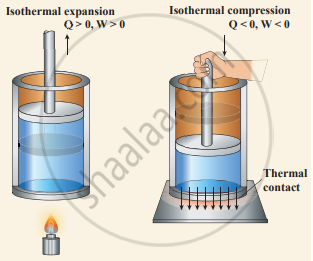
Isothermal expansion and isothermal compression
From equation (3), we infer that the heat supplied to gas is used to do only external work. It is a common misconception that when there is a flow of heat to the system, the temperature will increase. For the isothermal process, this is not true. The isothermal compression takes place when the piston of the cylinder is pushed. This will increase the internal energy which will flow out of the system through thermal contact.
APPEARS IN
RELATED QUESTIONS
Draw a p-V diagram of the reversible process.
Explain graphically (i) positive work with varying pressure, (ii) negative work with varying pressure, and (iii) positive work at constant pressure.
When a cycle tyre suddenly bursts, the air inside the tyre expands. This process is ____________.
Apply first law for an isothermal process.
Draw the PV diagram for the isothermal process.
Draw the PV diagram for the isochoric process.
Derive the work done in an adiabatic process.
Explain in detail the isochoric process.
A monoatomic gas of pressure p having volume V expands isothermally to a volume 2V and then adiabatically to a volume 16V. The final pressure of the gas is ____________.
`("ratio of specific heats" = 5/3)`
The work done on the system in changing the state of a gas adiabatically from equilibrium state A to equilibrium state B is 22.4 J. If the gas is taken from state A to B through another process in which the net heat absorbed by the system is 15.5 cal, then the net work done by the system in the latter case is ______.
( l cal = 4.2 J)
