Advertisements
Advertisements
प्रश्न
Explain in detail the isothermal process.
Advertisements
उत्तर
Isothermal process: It is a process in which the temperature remains constant but the pressure and volume of a thermodynamic system will change. The ideal gas equation is
PV = µRT
Here, T is constant for this process So the equation of state for the isothermal process is given by
PV = Constant ..................…(1)
This implies that if the gas goes from one equilibrium state (P1, V1) to another equilibrium state (P2, V2) the following relation holds for this process
P1V1 = P2V2 ….............(2)
Since PV = constant, P is inversely proportional to `"V" ("P" ∝ 1/"V")`. This implies that the PV graph is a hyperbola. The pressure-volume graph for constant temperature is also called isotherm. We know that for an ideal gas the internal energy is a function of temperature only. For an isothermal process since the temperature is constant, the internal energy is also constant. This implies that dU or ∆U = 0.
For an isothermal process, the first law of thermodynamics can be written as,
Q = W …...........(3)
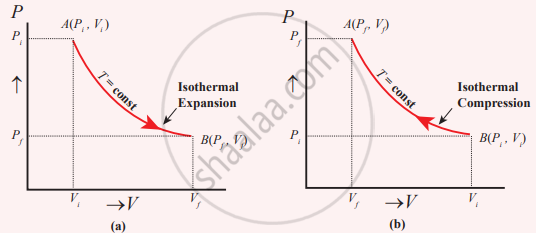
(a) Quasi-static isothermal expansion (b) Quasi-static isothermal compression
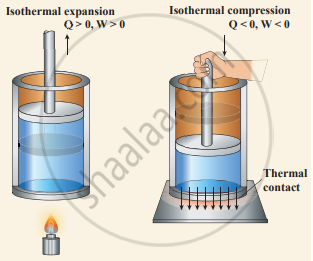
Isothermal expansion and isothermal compression
From equation (3), we infer that the heat supplied to gas is used to do only external work. It is a common misconception that when there is a flow of heat to the system, the temperature will increase. For the isothermal process, this is not true. The isothermal compression takes place when the piston of the cylinder is pushed. This will increase the internal energy which will flow out of the system through thermal contact.
APPEARS IN
संबंधित प्रश्न
A thermodynamic system is taken from an original state to an intermediate state by the linear process shown in Figure
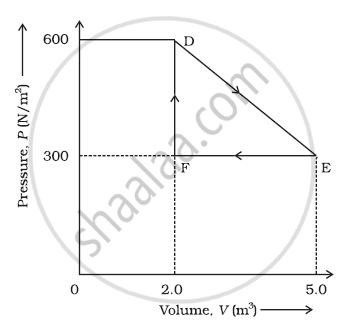
Its volume is then reduced to the original value from E to F by an isobaric process. Calculate the total work done by the gas from D to E to F
An ideal gas of volume 2 L is adiabatically compressed to (1/10)th of its initial volume. Its initial pressure is 1.01 x 10⁵ Pa, calculate the final pressure. (Given 𝛾 = 1.4)
Explain work done during a thermodynamic process.
Give the equation of state for an adiabatic process.
Draw the TP diagram (P-x axis, T-y axis), VT(T-x axis, V-y axis) diagram for
- Isochoric process
- Isothermal process
- Isobaric process
In a petrol engine, (internal combustion engine) air at atmospheric pressure and temperature of 20°C is compressed in the cylinder by the piston to `1/8` of its original volume. Calculate the temperature of the compressed air. (For air γ = 1.4)
An ideal gas is expanded isothermally from volume V1 to volume V2 and then compressed adiabatically to original volume V1. If the initial pressure is P1, the final pressure is P3 and net work done is W, then ____________.
For an isothermal expansion of a perfect gas, the value of `(Delta "P")/"P"` is equal to ____________.
In the figure shown here, the work done in the process ACBA is ______.

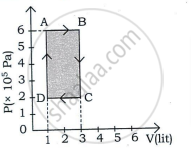
An ideal gas is taken through a cyclic process ABCDA as shown in figure. The net work done by the gas during the cycle is ______.