Advertisements
Advertisements
प्रश्न
For a given ideal gas 6 × 10⁵ J heat energy is supplied and the volume of gas is increased from 4 m3 to 6 m3 at atmospheric pressure. Calculate
- the work done by the gas
- change in internal energy of the gas
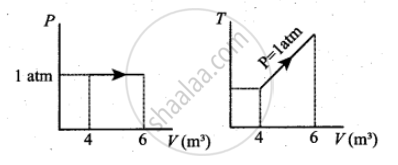
- graph this process in PV and TV diagram
Advertisements
उत्तर
Heat energy supplied to gas Q = 6 × 10⁵ J
Change in volume ∆V = (6 – 4) = 2 m3
1 atm = 1.013 × 10⁵ Nm−2
a. Work done by the gas W = P × ∆V
= 1.013 × 105 × 2
= 2.026 × 10⁵
W = 202.6 kJ
b. Change in internal energy of the gas
∆U = Q − P. ∆V
= 6 × 10⁵ − (202.6 × 10³)
= 6 × 10⁵ − 2.026 × 105
= 3.974 × 10⁵
∆U = 397.4 kJ
c.
APPEARS IN
संबंधित प्रश्न
Explain why The climate of a harbour town is more temperate than that of a town in a desert at the same latitude.
Draw a p-V diagram showing negative work with varying pressure.
State the assumptions made for thermodynamic processes.
Differentiate between the reversible and irreversible processes.
Give an expression for work done in an isothermal process.
Derive the work done in an isothermal process.
Explain in detail an adiabatic process.
Two identical samples of a gas are allowed to expand (i) isothermally (ii) adiabatically. Work done is ____________.
Which of the following processes is reversible?
Explain the thermodynamic process.
