Advertisements
Advertisements
प्रश्न
What are the limitations of the first law of thermodynamics?
Advertisements
उत्तर
Limitations of the first law of thermodynamics: The first law of thermodynamics explains well the inter convertibility of heat and work. But it does not indicate the direction of change.
For example,
(a) When a hot object is in contact with a cold object, heat always flows from the hot object to the cold object but not in the reverse direction. According to the first law, it is possible for the energy to flow from a hot object to a cold object or from a cold object to a hot object. But in nature, the direction of heat flow is always from higher temperature to lower temperature.
(b) When brakes are applied, a car stops due to friction and the work done against friction is converted into heat. But this heat is not reconverted to the kinetic energy of the car. So the first law is not sufficient to explain many natural phenomena.
APPEARS IN
संबंधित प्रश्न
What is a thermodynamic process?
3 mole of a gas at temperature 400 K expands isothermally from an initial volume of 4 litres to a final volume of 8 litres. Find the work done by the gas. (R = 8.31 J mol-1 K-1)
When a cycle tyre suddenly bursts, the air inside the tyre expands. This process is ____________.
Draw the PV diagram for the isochoric process.
Derive the work done in an adiabatic process.
Draw the TP diagram (P-x axis, T-y axis), VT(T-x axis, V-y axis) diagram for
- Isochoric process
- Isothermal process
- Isobaric process
An ideal gas is expanded isothermally from volume V1 to volume V2 and then compressed adiabatically to original volume V1. If the initial pressure is P1, the final pressure is P3 and net work done is W, then ____________.
An ideal gas is compressed to half its initial volume by means of several processes. Which of the process results in the maximum work done on the gas?
Consider P-V diagram for an ideal gas shown in figure.
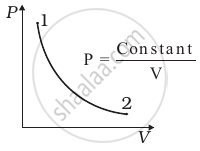
Out of the following diagrams (figure), which represents the T-P diagram?
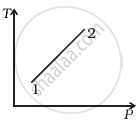 (i) |
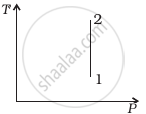 (ii) |
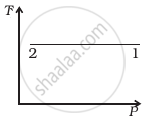 (iii) |
 (iv) |
In a certain thermodynamical process, the pressure of a gas depends on its volume as kV3. The work done when the temperature changes from 100°C to 300°C will be ______ nR, where n denotes number of moles of a gas.
