Advertisements
Advertisements
प्रश्न
What is a thermodynamic process?
Advertisements
उत्तर
A thermodynamic process is the change of state of a thermodynamic system due to the exchange of heat or work with its surroundings is called a thermodynamic process.
APPEARS IN
संबंधित प्रश्न
Explain why The climate of a harbour town is more temperate than that of a town in a desert at the same latitude.
Give an example of some familiar process in which heat is added to an object, without changing its temperature.
Answer in brief.
Why should a Carnot cycle have two isothermal two adiabatic processes?
Heating a gas in a constant volume container is an example of which process?
Draw a p-V diagram of the irreversible process.
Draw a p-V diagram showing positive work with varying pressure.
Draw a p-V diagram showing positive work at constant pressure.
State the assumptions made for thermodynamic processes.
An ideal gas of volume 2 L is adiabatically compressed to (1/10)th of its initial volume. Its initial pressure is 1.01 x 10⁵ Pa, calculate the final pressure. (Given 𝛾 = 1.4)
Explain the thermodynamics of the isochoric process.
Apply first law for an adiabatic process.
Draw the PV diagram for the adiabatic process.
Draw the PV diagram for the isobaric process.
Derive the work done in an adiabatic process.
Draw the TP diagram (P-x axis, T-y axis), VT(T-x axis, V-y axis) diagram for
- Isochoric process
- Isothermal process
- Isobaric process
In an adiabatic expansion of the air, the volume is increased by 4%, what is the percentage change in pressure? (For air γ = 1.4)
In a petrol engine, (internal combustion engine) air at atmospheric pressure and temperature of 20°C is compressed in the cylinder by the piston to `1/8` of its original volume. Calculate the temperature of the compressed air. (For air γ = 1.4)
An ideal gas is taken in a cyclic process as shown in the figure. Calculate
- work done by the gas
- work done on the gas
- Net work done in the process

For a given ideal gas 6 × 10⁵ J heat energy is supplied and the volume of gas is increased from 4 m3 to 6 m3 at atmospheric pressure. Calculate
- the work done by the gas
- change in internal energy of the gas
- graph this process in PV and TV diagram
In which of the following processes, beat is neither absorbed nor released by a system?
An ideal gas A and a real gas B have their volumes increased from V to 2V under isothermal conditions. The increase in internal energy ____________.
Assertion: Equal volumes of monatomic and polyatomic gases are adiabatically compressed separately to equal compression ratio `("P"_2/"P"_1)`. Then monatomic gas will have greater final volume.
Reason: Among ideal gases, molecules of a monatomic gas have the smallest number of degrees of freedom.
An ideal gas is compressed to half its initial volume by means of several processes. Which of the process results in the maximum work done on the gas?
Consider P-V diagram for an ideal gas shown in figure.
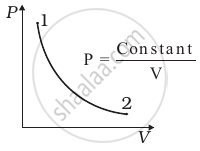
Out of the following diagrams (figure), which represents the T-P diagram?
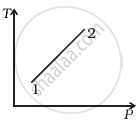 (i) |
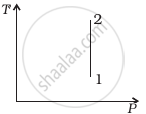 (ii) |
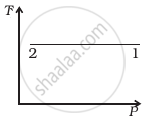 (iii) |
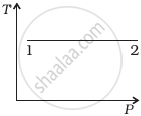 (iv) |
Give any two types of a thermodynamic process.
In a certain thermodynamical process, the pressure of a gas depends on its volume as kV3. The work done when the temperature changes from 100°C to 300°C will be ______ nR, where n denotes number of moles of a gas.
Explain the thermodynamic process.
When an inflated ballon is suddenly burst, why is the emerging air slightly cooled?
In a cyclic process, if ΔU = internal energy, W = work done, Q = Heat supplied then ______.
