Advertisements
Advertisements
प्रश्न
What is a cyclic process?
Advertisements
उत्तर
This is a thermodynamic process in which the thermodynamic system returns to its initial state after undergoing a series of changes. Since the system comes back to the initial state, the change in the internal energy is zero. In the cyclic process, heat can flow into the system and heat flows out of the system. From the first law of thermodynamics, the net heat transferred to the system is equal to the work done by the gas.
Qnet = Qin – Qout = W (for a Cyclic Process)
APPEARS IN
संबंधित प्रश्न
Give an example of some familiar process in which heat is added to an object, without changing its temperature.
Draw a p-V diagram of the irreversible process.
Apply first law for an adiabatic process.
Draw the PV diagram for the adiabatic process.
Explain in detail an adiabatic process.
What are the limitations of the first law of thermodynamics?
An ideal gas is expanded isothermally from volume V1 to volume V2 and then compressed adiabatically to original volume V1. If the initial pressure is P1, the final pressure is P3 and net work done is W, then ____________.
Ideal gas for which 'ϒ' = 1.5 is suddenly compressed to `1/4`th of its initial volume. The ratio of 4 the final pressure to the initial pressure is ______.
`(ϒ = "C"_"p"/"C"_"v")`
Consider P-V diagram for an ideal gas shown in figure.
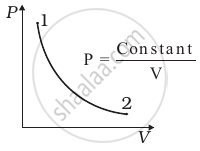
Out of the following diagrams (figure), which represents the T-P diagram?
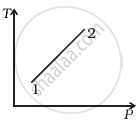 (i) |
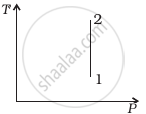 (ii) |
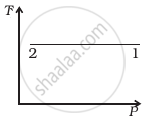 (iii) |
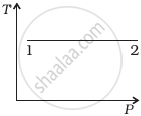 (iv) |
When an inflated ballon is suddenly burst, why is the emerging air slightly cooled?
