Advertisements
Advertisements
प्रश्न
Answer in brief.
Why should a Carnot cycle have two isothermal two adiabatic processes?
Advertisements
उत्तर
There are basically two processes:
- Exchange of heat (steps A to B and C to D). For this to be reversible, the heat exchange must be isothermal. This is possible if the working substance is at the temperature TH of the source while absorbing heat. The working substance should be at the temperature of the cold reservoir TC while rejecting the heat.
- Work done (steps B to C and D to A). For work done to be reversible, the process should be adiabatic.
Thus, the cycle includes two isothermal and two adiabatic processes for maximum efficiency.

Carnot cycle
APPEARS IN
संबंधित प्रश्न
Explain why The climate of a harbour town is more temperate than that of a town in a desert at the same latitude.
A thermodynamic system is taken from an original state to an intermediate state by the linear process shown in Figure
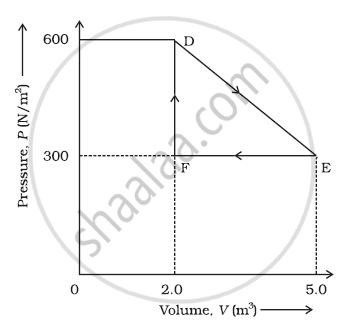
Its volume is then reduced to the original value from E to F by an isobaric process. Calculate the total work done by the gas from D to E to F
For work done to be reversible, the process should be ______
Heating a gas in a constant volume container is an example of which process?
Draw a p-V diagram of the reversible process.
Draw a p-V diagram showing positive work with varying pressure.
Differentiate between the reversible and irreversible processes.
Write a note on free expansion.
Explain work done during a thermodynamic process.
When food is cooked in a vessel by keeping the lid closed, after some time the steam pushes the lid outward. By considering the steam as a thermodynamic system, then in the cooking process
When you exercise in the morning, by considering your body as a thermodynamic system, which of the following is true?
In an isochoric process, we have ____________.
Give an expression for work done in an isothermal process.
Apply first law for an adiabatic process.
Give an equation state for an isochoric process.
Draw the PV diagram for the isothermal process.
Draw the PV diagram for the adiabatic process.
Draw the PV diagram for the isochoric process.
What is meant by a reversible and irreversible processes?
Explain the isobaric process and derive the work done in this process.
Explain in detail the isochoric process.
In an adiabatic expansion of the air, the volume is increased by 4%, what is the percentage change in pressure? (For air γ = 1.4)
An ideal gas A and a real gas B have their volumes increased from V to 2V under isothermal conditions. The increase in internal energy ____________.
Assertion: Equal volumes of monatomic and polyatomic gases are adiabatically compressed separately to equal compression ratio `("P"_2/"P"_1)`. Then monatomic gas will have greater final volume.
Reason: Among ideal gases, molecules of a monatomic gas have the smallest number of degrees of freedom.
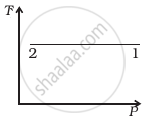
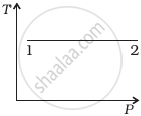
Consider P-V diagram for an ideal gas shown in figure.
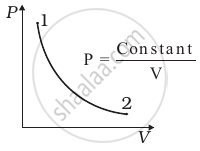
Out of the following diagrams (figure), which represents the T-P diagram?
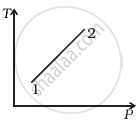 (i) |
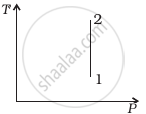 (ii) |
 (iii) |
 (iv) |
In a cyclic process, if ΔU = internal energy, W = work done, Q = Heat supplied then ______.
