Advertisements
Advertisements
प्रश्न
Explain thermodynamics of the adiabatic process.
Advertisements
उत्तर
- An adiabatic process is a process during which there is no transfer of heat from or to the system.
- For adiabatic change, Q = 0.
∴ ΔU + W = 0
∴ ΔU = –W - This implies, for adiabatic expansion, W is positive and ΔU is negative i.e. when work is done by the system adiabatically its internal energy decreases.
- Similarly, when a system is compressed adiabatically, W is negative and ΔU is positive i.e., the internal energy of the system increases in an adiabatic compression.
- Heat transfer to and from the system is prevented by either perfectly insulating the system from its environment or by carrying out the change rapidly so that there is no time for any exchange of heat.
- The temperature of the system changes, i.e., ΔT ≠ 0
- Usually, it is a sudden change and the system does not find any time to exchange heat with its environment.
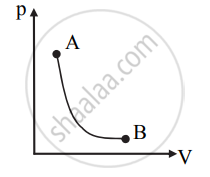
- p-V diagram for the adiabatic process is as shown below:
APPEARS IN
संबंधित प्रश्न
Explain why The climate of a harbour town is more temperate than that of a town in a desert at the same latitude.
For work done to be reversible, the process should be ______
What is a thermodynamic process?
Draw a p-V diagram of the reversible process.
Draw a p-V diagram of the irreversible process.
Draw a p-V diagram showing positive work with varying pressure.
Draw a p-V diagram showing negative work with varying pressure.
Draw a p-V diagram showing positive work at constant pressure.
State the assumptions made for thermodynamic processes.
Write a note on free expansion.
Explain the thermodynamics of the isochoric process.
Apply first law for an isothermal process.
Apply first law for an isobaric process.
Draw the PV diagram for the isothermal process.
Draw the PV diagram for the isobaric process.
Derive the work done in an isothermal process.
Explain the isobaric process and derive the work done in this process.
Explain in detail the isochoric process.
In an adiabatic expansion of the air, the volume is increased by 4%, what is the percentage change in pressure? (For air γ = 1.4)
In a petrol engine, (internal combustion engine) air at atmospheric pressure and temperature of 20°C is compressed in the cylinder by the piston to `1/8` of its original volume. Calculate the temperature of the compressed air. (For air γ = 1.4)
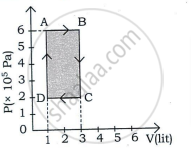
An ideal gas is taken in a cyclic process as shown in the figure. Calculate
- work done by the gas
- work done on the gas
- Net work done in the process

An ideal gas is made to go from a state A to stale B in the given two different ways (see figure) (i) an isobaric and then an isochoric process and (ii) an isochoric and then an isobaric process. The work done by gas in the two processes are W1 and W2 respectively. Then,

Two identical samples of a gas are allowed to expand (i) isothermally (ii) adiabatically. Work done is ____________.
In which of the following processes, beat is neither absorbed nor released by a system?
Which of the following processes is reversible?
Give any two types of a thermodynamic process.
An ideal gas is taken through a cyclic process ABCDA as shown in figure. The net work done by the gas during the cycle is ______.
In a cyclic process, if ΔU = internal energy, W = work done, Q = Heat supplied then ______.
